How do you know it's time to stop writing the paper for your upcoming conference and go to bed?
When your monitor display suddenly turns sideways. As in, the whole thing: task bar, text, everything.
It turns out that the video card in my new desktop machine has this capability -- if my old one did, I never encountered it. If you purposely (or accidentally, as in my case) hit Ctrl-Alt- arrow key, your display goes wacky. But then you can toggle it back.
But there's nothing quite like trying to read stupid Help screens sideways -- to no avail -- I Googled the problem after a few minutes and found my answer quickly.
But now I have a neck crick. And I'm tired anyway.
p.s. There really should be a rule that conferences can't be scheduled during the first month of classes. I'm so not ready to shift gears all of a sudden, since I have barely gotten into teaching mode.
8/28/2006
8/25/2006
how important is 1/8?
My U doesn't have any official "passing time" between class timeblocks. So one class is scheduled 11:30-1:00, the next is 1:00-2:30, the next is 2:30-4:00 (for the 90 minute blocks; there are others, for different kinds of courses). So, most faculty let their students go with about 10 minutes to spare before the next class hour starts, to allow them to walk to other buildings, etc. Occasionally I might run into that time and let them out with 8 minutes, or a little less; occasionally I might let them go with 15 minutes, if we've reached a good stopping point right then.
One of my students came up after class on Tuesday and explained that the professor in her class before mine runs class right up until 1:00, and she has to sprint across campus. She will probably be a few minutes late, nearly every day -- but that's not her fault. I'm glad she explained what the situation was, and it's slightly irritating, but she's been very good about trying to get to class as quickly as possible.
Also on Tuesday, in the same class, after I went over the syllabus and explained the set up of the course, I asked if anyone had any questions, before we moved on to the lecture/discussion part of the session. A student raised her hand, and when I called on her, she said "I have to leave early." I said, "Today?" and she said "I have to leave early every day, at 2:10, so I can pick up my children."
This really wasn't a question, of course -- she was simply telling me that she would be leaving. Add to that the ideology that assumes that because she's a mother all rules don't apply to her. That really irritates me. Because frankly, it's all the same to me why you think you have to leave. I don't really see why I should be accomodating in this instance. Why sign up for a course that you know you will be missing 1/8 of? But I also don't see what I can do about it. I can't bar the door, or drop her from the course.
So I told her that she'd better sit near the door so she wouldn't disrupt the other students when she left. She sucked her teeth at me about that, but on Thursday she complied. After class on Tues, another student came up and explained that she too would have to leave at 2:10 to pick up her kid, and that she'd sit by the door as well.
So they slipped out while I was still talking, which of course created a ripple effect of glances and restlessness among other students. This is going to be very frustrating every afternoon. And I refuse to go out of my way to make sure they get any handouts, announcements, or information that I deliver in the last 10-15 minutes of the class. It's their responsibility to find out what they missed, just the same as if they missed a full day due to illness.
Grr. Now my task is to not let my irritation with their poor choices interfere with my assessment of their participation and performance in other aspects of my class.
8/23/2006
and so it begins
Yesterday was my first actual teaching day, and I'm pretty pleased with my schedule, my courses, and my students. The past two days were a horrible foggy blur since I had a horrendous bout of allergies (just like Julie)
-- or at least I'd prefer to think it was allergies and not a cold (because somehow that seems less my fault -- though of course genetic weakness is hardly a thing to be prized either) (yeah, I know, it's all crazy thinking, but I really, really, HATE to feel sickish) -- in any case, I didn't really sleep Sunday or Monday night because I kept coughing. I was even dreaming about having to cough. And then once I was vertical, I was sneezing and blowing my nose all day long. Not exactly a good way to start off the semester (though I did manage to not have to actually blow my nose in the classroom, which would be kinda embarrassing on the first day). Time will tell whether my husky phlegm-induced Lauren Bacall voice scared the students off on the first day (or made some of them stay?).
But this morning, I woke up feeling rested, and I could breathe easily. There's a little residual chest congestion, but my nose is totally clear, my brain is working again, and I feel like my own self, not Phlegm Monster. Yay! (We did have a weather shift that might have changed the allergens -- or maybe it was a baby cold that my garlic and herbal treatment knocked out-- I'm just happy it's over.)
Now, a day of finishing up all the organizational stuff (gradebook spreadsheet, scanning, WebCT, reserves desk, etc) and I'll be in the teaching groove again.
8/21/2006
aging (a good thing)
I finally must be looking like my actual age. For years, I've put up with well-meaning (or not so well-meaning) comments like "you can't possibly be a professor" or "you look like you're 20 -- you'll be happy about that someday." I've grown a tough skin about such comments, and thankfully I haven't been carded for an R movie since I was about 27, but it still can be irritating. I don't, after all, randomly tell strangers "you look really old -- what do you mean you're only 40? I thought you were 60." But in any case, I think things are starting to change.
Sign #1: I'm teaching in a media-equipped classroom this semester, and in order to use the equipment I need a special key that the Classroom Support office guards jealously. They've restructured their offices, so last week I went to one place to get the key, only to be told to phone another office. I did, and was told to email someone. I emailed on Tuesday, and again on Thursday, and made another phone call on Friday. I was really making an effort to get the key before today, before the start of classes -- both because I actually need to use the equipment tomorrow, and because I know the first week is a zoo. Well, about 4:45 on Friday I was told that the key would be available for pickup Monday afternoon at the IT service counter -- the same place all the students go to get their new logon IDs etc. Exactly what I was trying to avoid.
So I walk over there, and as I approach the line, which had extended well into the hallway, a staff member walks up to me and says "hi, are you here to pick up something?" She ferried me behind the counter and found someone who knew how to unlock the special drawer where the keys were kept. She didn't know me personally, but I must have looked enough like faculty to be able to be spotted in a room full of 20-somethings. This was one occasion I was happy to get a little dose of faculty privilege. And without having to go through some rigamarole about proving that I really was who my faculty ID card says I am.
Sign #2: none of the guys manning the student organization booths on the central quad whistled, tried to chat me up, or even looked at me. I think I've finally reached middle-aged invisibility, which in these instances is a Really Good Thing.
8/19/2006
last weekend
Ahhh, Saturday. This was a really busy week at the U, getting things ready before classes start Monday morning. I had two 7:30 a.m. meetings this week, which meant that my wacked-out sleep schedule of the past month got a stiff kick in the rear. I'd like to be a consistently early riser -- I think it's actually better for my mental health to get up early. I know it's better for my physical health if I get up at the same time every day. But sometimes staying up late is just so appealing. When I was younger, I was definitely a late-night person. So I have those tendencies too. In any case, after three days in a row of getting up at 6, (and 7 today) I'm now getting in the groove. I'd like to get up at 6 or 6:30 most days I think -- although my normal routine does NOT involve being dressed, caffeinated, and on the road before 7:00 a.m. -- thankfully. But if I can get up that early and do the morning walks, it would give me some good work time before needing to shift gears into teaching mode for the afternoon and evening. (My faithful readers will remember that at the beginning of the summer I was talking about a similar getting up early plan. It worked for a while, and then my sleep cycles started to drift...) I've been reading Steve Pavlina's tips on sleep management and going to give it another try.
I'm looking forward to my classes -- I've substantially reworked both of my courses for the semester, and I'm using a number of new readings, so I've got a lot of new prep to do, but I'm pleased with the changes I've made. I have a half-written post about teaching (in response to the great Teaching Carnival posts I've been reading) -- maybe I can actually finish it this weekend.
Mostly, though, I was working such long days at the office that when I got home the last thing I wanted to do was sit in front of the computer, or even read anything. GF and I watched the last DVD available of BSG -- aarrggh! negativecapability warned me that at the break midway in season 2 there was a horrible cliffhanger -- she's so right. Now we have to wait until midSeptember when the DVD of season 2.5 comes out.
Last night we went to see Scoop, which was a lot of fun. The last few Woody Allen films I've seen have really grown on me. And Scarlet Johannsen doesn't irritate me so much as she used to -- I was never entirely sure if it was her, or the pedophilic movies she was in originally. (Lost in Translation completely icked me out, even though I know so many people loved it.) But now that she's getting a bit older, I like her better. (And even though she's clearly Woody Allen's current muse, she's not portrayed as his sexual interest in any of these recent films they've done together.) I'm curious, too, about the cluster of films this year that deal with illusionists -- this one is comic, but there's also The Prestige and The Illusionist coming out soon, and they both look really interesting. Random coincidence? Deeper cultural pattern?
Last weekend we also saw The Descent, and Shadowboxer. The Descent is basically a better version of The Cave, with an all-female cast. If you like entrapment/disaster adventure-thrillers, you can't hardly go wrong with this one. The basic premise of both films is pretty standard (expedition goes awry, bad stuff happens, some people die, some make it) -- and I've been told there's a Scottish folk tale about cannibals that lies behind these movies as well as lots of other horror films. But what's interesting to me are the anxieties about evolution that these films play on. In each case there are creatures in the caves (oh, don't tell me you didn't know that -- you can still see the movie) that used to be human, but have adapted to life underground and have become something else. The protagonists need climbing gear and lights and other equipment, but the slithery creatures don't . . . these fears about the direction of human development are very 19th century in some ways.
In contrast to most of the critics, I really, really liked Shadowboxer. It's not for everybody -- it's extremely violent, dark, sexy, and perverse. But I found it visually and intellectually satisfying. The look of the film is incredibly beautiful, and Helen Mirren and Cuba Gooding Jr are wonderful together. It's The Grifters meets Oedipus in a Euro-hip-hop fusion that looks like nothing else on screen right now. Over the top, melodramatic, but compelling -- terminal cancer, hired killers, mob lords, and a crazy Macy Gray. Mo'Nique does a great performance as a crack-addicted nurse named Precious, paired off with Joseph Gordon-Levitt -- their subplot could almost have been a whole movie on its own -- you want to know more about lots of the peripheral characters. There's a richness to this world that fills out the noir plot and draws you in.
The fall looks like it will be full of good films. . . and I'm so excited about Viva Pedro. I think it's interesting that they're putting the darker, earlier films (like Matador) last in the retrospective, after pulling in audiences with the crowdpleasing romps like Women on the Verge. Smart from a marketing perspective, but not historical enough for my liking. And of course there are all the other Almodovar films that they're not re-releasing. I think I saw all of these during their original release, but I'll definitely go out to see them again on the big screen.
My weekend plans involve: more course planning and prep; working on a conference paper; finishing my closet purge; working out; hanging out with GF and the dogs who I've barely seen for a few days; and maybe another movie (the lines last week for Little Miss Sunshine were too annoying, but maybe we can sqeeze in a matinee today). And a haircut for the start of the semester. It does NOT involve going in to campus, which right now makes me very, very happy.
8/15/2006
small manageable bits
I have to make more progress on my course designs today, and I have to manage my rising anxiety and distraction about work, upcoming travel, and the fact that Old Girl is having a biopsy today at the vet hospital. So, here's a list of course related things that I'm going to focus on today and tomorrow:
I'll be so much happier once the semester really gets underway. I'm teaching courses I like, updated with some new books, and I have a good schedule. But right now there's a lot to do and I'm feeling distracted.
make final choices of readings from textbook for course Aread through last year's assignments for course Aplan new assignments for course A- revise boilerplate for syllabus A
calendarize course Aplan first day activity for course A- write new policies for course B
- finish revising assignments for course B
- decide about library trips for course B
- select supplementary readings for course B
- revise boilerplate for syllabus B
- calendarize course B (this is going to be the tricky one)
- plan first day activity for course B
- create WebCT module for course A
- create WebCT module for course B
- delete/file emails
- purge filing cabinet
I'll be so much happier once the semester really gets underway. I'm teaching courses I like, updated with some new books, and I have a good schedule. But right now there's a lot to do and I'm feeling distracted.
8/13/2006
shopping happiness
Every August, I get the urge to purge my closet and go clothes shopping as part of my back-to-school preparations. Partly, I think it's the slight confusion I feel, faced with the prospect of putting together teaching outfits next week, when I've been wearing jeans, cargo pants, and t-shirts all summer. Simply remembering what I used to wear to work seems like an effort. Plus, there's the slow decay of my wardrobe. I weed out a few things every year, but I'm thinking I need to start timestamping my clothes. After five years, most of my jackets and pants really need to be put out of rotation (I'm not that into "timeless" "classics". Especially since the cut of even basic clothes changes.)
This year I feel more frustrated than usual with my wardrobe, since I've lost a few inches and many of my clothes no longer fit the same. I'm going to have to re-hem most of my pants, since they're hanging down lower now. Some things I can just wear baggier, but some are really looking like shapeless sacks.
So yesterday I gave in to the urge and did a little shopping. And for the first time in years, I am so happy with the styles in the stores. My essential, fundamental tastes in fashion and music were formed in the 80s. So I was thrilled to find skinny black jeans and these boots on sale. They remind me of both my favorite elf boots from high school, and the punk boots I wore in college. There are other 80s styles I'm not interested in -- those shirts with huge ruffles down the front, for instance -- but I'm psyched that pants are finally narrowing. Flared pants are just not that good on a shorter person. Old Navy was rocking an awesome 80s soundtrack while I was in there, too... it's almost enough to make me bust out some purple eyeliner. (I already switched to a more extreme hair product a month or two ago.)
It's been a long, long time since I felt this excited about getting some new clothes. Of course, this isn't a full wardrobe overhaul yet, but now I feel even more motivated to clear the big baggy pants out of my closet.
8/12/2006
comedy
Sometimes you really just need to laugh. But comedy is really tricky for me-- there's
a lot of stuff that other people find hilarious that just doesn't seem that amusing to me. And then, once in a while, there's a film that really just tickles me. Last night we went to see Talladega Nights, and I was really pleasantly surprised. I haven't laughed that much in a movie theater in a long time. It helped, too, that we were in a crowded room, with mostly adults, not just teenagers -- there's something communal and therapeutic about laughing with other people.
Anyway, why did I like this movie? Besides the fact that John C Reilly and Will Farrell were hilarious (especially since we'd last watched Will Farrell try to be Woody Allen in Melinda and Melinda -- which I liked, except for his performance, which was mostly just painful to watch). And that the ever-amusing Jane Lynch was in it, and various other people too. But even though it's a comedy about NASCAR drivers, it was actually really kind of sensitive underneath the gags. The humor was largely verbal, rather than physical (always a plus for me), and it was not hateful or mean.
It's a movie about Southerners that isn't mocking the South. It's a movie about the homosocial world of racing that does not veer into homophobia -- when the openly gay French driver (played by Sacha Baron Cohen) shows up to put Will Farrell's career to rest, the film could have turned really ugly. I'm always nervous at moments like those. But instead, the film pokes fun at homophobia itself, and by the time Farrell locks lips with Cohen, the audience we were watching with didn't groan or squirm uncomfortably.
Underneath it all, it's a movie about male friendship, and about believing in yourself. Facing your fear and finding your self-esteem internally rather than externally. Nothing new, nothing that hasn't been the structure of many other Hollywood films. But it infuses this comedy with a a generous spirit, one that made me feel safe to laugh and enjoy myself. (Unlike, for instance, My Super Ex Girlfriend, which was so misogynistic and homophobic that we walked out after 10 minutes and saw John Tucker Must Die instead. Which, as a mashup of Heathers and Mean Girls, was way better than the former waste of Wilson and Thurman talent.)
I realize that in talking about the movie in this way, I'm not really conveying the hilarity of it. But when Ricky Bobby begins saying grace at the dinner table, "Dear sweet baby Jesus" and his family gets in an argument about the right way to picture Jesus, I was dying laughing. Or when he crashes his car and runs around convinced he's burning with invisible fire. It's definitely going in the corner of our DVD shelf designed for making Crappy Days better.
8/10/2006
ups and downs
down: I can't wake up this morning. Just can't.
up: GF volunteers to take care of the morning dogwalks for me and I sleep for several more hours.
down: half the day is gone when I do finally wake up.
up: I decide NOT to go into the office, as this is the last day I can get away with that kind of behavior.
down: summer is really ending/ended.
up: I set my goals for the day, trying to achieve something.
Extra UP: I get an email that my new computer has shipped early! (After my hard drive crashed I decided it was finally time to give in to my itch for a new machine. It already needed a new CD drive, and the hard drive, and who knows what else would be next...) FedEx tracker claims it will arrive today!
down: every time I hear a truck outside, or a noise remotely resembling a truck, I go and peek out the window. But it's not FedEx.
up: I get some work done.
down: it starts to thunder and I am the only person in the house. Three dogs, one of whom is very nervous about storms, attach themselves to me. I give up on work and read for one of my classes, since I have to pause every 30 seconds to wipe dog slobber or pet somebody.
up: weather clears
down: FedEx updates their tracker and my package has spent the entire day sitting in a warehouse 5 hours from here. Now it says it will arrive on Saturday.
up: I had a relaxing day in my house
down: I didn't get enough done, and I'm feeling the slow rise of panic about end of summer/beginning of term.
up: I'll still be getting my new computer 6 days earlier than they'd originally said.
down: I have a LOT to do (work, organizing, etc) so that I can play around with it if/when it comes.
yup, I'm all over the emotional map today.
8/09/2006
Reading for Pleasure Wednesday
As the semester looms nearer, my pleasure reading tends more and more towards light things and SF. I'm almost finished with Jack McDevitt's Seeker, which I picked up at the library without realizing it was a sequel. But I'm not having any trouble getting into the characters or their world without knowing the earlier books. Set way, way, in the future, in a time that looks back to the beginning of interplanetary travel as an age of antiques worth collecting, the novel focuses on a couple of artifact hunters searching for a derelict space ship that once belonged to a freedom-seeking sect. There are puzzles to be solved, ethical issues about the collection and distribution of artifacts, and interactions with a telepathic alien species. Engaging, well written for SF, entertaining.
8/07/2006
20 years
My 20th high school reunion will be taking place in a couple of weeks. I will not be going. I hated high school (only marginally less than I hated junior high school) and spent most of my time figuring out how to leave early.
There are a few friends I grew up with that I'm still in touch with, on a once-a-year Xmas card kind of basis. A couple of people are still living in our home town, and I see them when I visit my mother. But by and large I've been able to forget most of the people and events associated with high school. Or so I thought.
I'd never gotten any information about the 10-year and had thought I'd remained below the radar of the ex-student-council types. But someone passed my email along to the people who are organizing this reunion. They're circulating all information about it electronically, which makes sense in the current age. But they're doing this not via a website, like sane people -- but by sending email "blasts" (say that in perky cheerleader voice to get it just. right.) to everyone in our class who they have an email address for. This was a moderate-sized school, with maybe 350-400 people in our class. They've got emails for probably 250 at this point.
The best part? Various geniuses have been hitting "reply all" to send their enthusiastic comments and suggestions. Onegirl woman (sorry, but how can I think of her as an adult? in my mind she'll always be a preppy volleyball player) writes "hey, Joe Smith, can you still dunk a basketball? Kristi I loved your hair!! Kurt Henderson, remember barfing after the big game?"* And then Joe has to write back about yes he can still dunk, etc. The "popular people" are having a frickin conversation in front of 200 other people . Nothing changes. (Of course, the fact that the middle-class popular people are organizing the reunion via email also means that the other half of our graduating class, the ones who have mostly melted back into the Appalachian underclass, are pretty much left out of the loop. Nothing changes.)
The weird thing about going to high school in a small town -- with people you'd known since junior high and sometimes elementary school -- is that you knew people's names. I thought I'd wiped those sectors of my personal memory bank, but the email list brings it back. It's oddly exhausting, just reading over the names of all these people I'd forgotten. I'm surprised I don't run into more people from high school when I'm in my home town, but it's not like I'd necessarily recognize them face to face, even if I recognize a name. I'm mildly curious about a few of them, but it'll be more than sufficient to hear about the reuinion from some friends who will go.
The other weird thing? Because of the laws of my home state, we were all pretty much the same age in each grade. (Except for the guys who got held back and had beards in 7th grade...) So these emails are full of other people's comments about being 38. And that's struck me, since I'm almost never in a situation with a whole room full of other people my age. I don't think any of my friends or colleagues are my age. It's weird to think that at one time I only knew people my own age.
It's all kind of sad, but funny too. And I have better things to do, but I just can't help myself from reading each idiotic message that scrolls across my inbox.
*names have been changed
There are a few friends I grew up with that I'm still in touch with, on a once-a-year Xmas card kind of basis. A couple of people are still living in our home town, and I see them when I visit my mother. But by and large I've been able to forget most of the people and events associated with high school. Or so I thought.
I'd never gotten any information about the 10-year and had thought I'd remained below the radar of the ex-student-council types. But someone passed my email along to the people who are organizing this reunion. They're circulating all information about it electronically, which makes sense in the current age. But they're doing this not via a website, like sane people -- but by sending email "blasts" (say that in perky cheerleader voice to get it just. right.) to everyone in our class who they have an email address for. This was a moderate-sized school, with maybe 350-400 people in our class. They've got emails for probably 250 at this point.
The best part? Various geniuses have been hitting "reply all" to send their enthusiastic comments and suggestions. One
The weird thing about going to high school in a small town -- with people you'd known since junior high and sometimes elementary school -- is that you knew people's names. I thought I'd wiped those sectors of my personal memory bank, but the email list brings it back. It's oddly exhausting, just reading over the names of all these people I'd forgotten. I'm surprised I don't run into more people from high school when I'm in my home town, but it's not like I'd necessarily recognize them face to face, even if I recognize a name. I'm mildly curious about a few of them, but it'll be more than sufficient to hear about the reuinion from some friends who will go.
The other weird thing? Because of the laws of my home state, we were all pretty much the same age in each grade. (Except for the guys who got held back and had beards in 7th grade...) So these emails are full of other people's comments about being 38. And that's struck me, since I'm almost never in a situation with a whole room full of other people my age. I don't think any of my friends or colleagues are my age. It's weird to think that at one time I only knew people my own age.
It's all kind of sad, but funny too. And I have better things to do, but I just can't help myself from reading each idiotic message that scrolls across my inbox.
*names have been changed
8/05/2006
weekend summary
If you looked at my browser's history list for the past two days, you would see:
- planting and care instructions for three different plants
- addresses and phone numbers for two local nurseries
- instructions for removing and for dressing the seat of a compression faucet
- pictures of a seat wrench and dressing tool
- directions for the use of boric acid in pest control
8/04/2006
what do you say, follow-up
I had asked the questions in my last post because I've been reflecting lately on my own conversational patterns and what they might mean. I recognize myself in many of the comments, so I know that these concerns are not unique to me alone, or my situation.
I tend to downplay what I do, in casual and even not-so-casual conversation. I spent most of my life before college being harassed and picked on by peers and teachers for being "smart," and I'm still very sensitive to the social ostracization that accompanies any faint whiff of intellect. Announcing that I have a PhD just seems like wearing a sign that says "kick me I'm too smart for my own good."
I never say "I am a professor," unless I'm in a professional situation where it's required -- though even then I'd be more likely to say "I'm faculty" -- I don't know why, but that seems less aggressive, or less prideful. I think, too, that I am so far from being the stereotypical tweedy middle-aged white male"professor" that I tend to distance myself from the word. (This might also have a bit of self-protectiveness in it, as when I was a young-looking new professor I routinely had to defend my credentials to the staff in the Parking office and at the campus library--being told I couldn't possibly be old enough to be faculty was incredibly irritating.) I also know that when I lived in smaller towns, places where there was one college that was a significant component of the economy, geography, or identity of the place, the concept of "professor" was a more meaningful one to a larger number of people. In a "college town," the categories of "students" and "faculty" are more homogenous and more familiar than they are to average citizens of a large city which contains several colleges of different types.
I tend to focus on teaching in my response because that's something that most people understand, or have at least encountered. Yes, it does mean that some people think I teach high school, but that doesn't really bother me. Yes, I get stupid replies like "I have to watch my grammar" but I'm used to that by now. For casual conversation, it's fine.
But lately I've realized that when the conversation is extended, or the acquaintanceship is an ongoing one, the teaching-focused answer isn't quite enough. Or when someone does know something about what it means to say that you teach at a college. Like this conversation which happened to me recently at yoga:
A: What do you do?
M: I teach at Large Urban University.
A: Really? What do you teach?
M: I teach [X Subject.]
A: What's your specialty?
M: [Y Subfield.]
A: You have a PhD?
M: Yes.
A: You're a doctor?
M: Unh-huh.
A: You're a professor? (imagine the last three remarks with increasing pitch and surprise)
M: Yes.
A: Wow. That's so amazing.
M: (shrugs, feeling really awkward)
This is where my lowkey strategy backfires, somehow making my job title into more of a focus rather than less of one. Or recently, I was chatting with another woman who I'm fairly friendly with at yoga -- she knows I'm a professor, and it hasn't been an issue. Out of the blue, she says "so, do you write?" and I was left confusedly saying "Yes" but also trying to figure out what she was really asking. Turns out she knew that faculty have to publish scholarship and was curious about what I did. But that was the first time in casual conversation that anyone has ever asked about what I write about. Usually when someone says that, they mean "do you write novels."
So lately, when it's conversationally appropriate, I've been experimenting with ways to talk a little about my work, all of the different pieces of it. I don't talk about my work that often even with other academics, so this has been a real stretch, but in a good way. But it's made me extra-aware of how guarded I tend to be, how I manage my responses based on the context or what I think I know about someone's background or education level.
Our culture doesn't have a clear concept of "professor" the way that "lawyer" or "medical doctor" circulates. People don't watch TV shows featuring academics. And even though many people have gone to college, and presumably encountered professors there, sometimes it seems as though we might as well be monks or CIA agents, members of mysterious cabals with secret behaviors that sometimes impact ordinary folk. Sometimes it's fun to play with people's assumptions. But sometimes I wish it wasn't quite so complicated.
8/03/2006
what do you say (a poll for the academics)
Here's a question. In casual conversation, when someone you don't know asks you what you do, how do you answer?
1a. I teach.
1b. I teach at [X College/University].
1c. I teach [X Subject]
2a. I work at [X College/University].
2b. I am a professor.
2c. I am a professor at [X College/University].
3a. I am a researcher.
3b. I research [X Topic]/
3c. I do research at [X College/University].
And why do you think you answer the way you do?
For myself, I tend to go with 1a, 1b, or 2a. Which then usually leads into a follow up statement about 1c.
I have more to say about this, but I'm curious to see what other people do, first.
Reading for Pleasure Wednesday
(Yeah, I know it's Thurs. I started this yesterday and got interrupted. )
The premise of Sue Miller's While I Was Gone is interesting --the heroine, Jo Becker, is a middle-aged veternarian with grown daughters and a comfortable life with her husband of 20 years. But long ago, when she was in her early twenties, she had a first marriage -- which she abandoned for a year, moving to a new city, changing her name, and living in a shared group house. When one of the men from that house shows up in her current life, she is forced to reassess who she really is, what she had been looking for, and how to make sense of her past in her present. But the last third of the book really dragged for me, and I found her character less and less appealing. Oh, and there's an unsolved murder from that past life also, just to sensationalize things. Certain moments, certain emotions, were well handled and interesting. But overall it was just OK. But I did care enough about it to finish the book. Perhaps if I were a baby boomer I would relate more to the book.
If stereotypical "chick lit" is about the trials and tribulations of singletons in the city, I'm not sure what booksellers are calling popular women's fiction that focuses on slightly older women, married women, etc. I think it all gets lumped together, which can be misleading. Jeanne Ray writes novels that remind me a bit of those of Sara Lewis, Claire Cook, and maybe Jennifer Weiner. Eat Cake is a quick, entertaining read (though I think I laughed more at Step Ball Change, one of her other novels) -- the sadness and hilarity that is family life. Add together under one roof fdivorced parents who don't get a long, a husband put out of work, a sulky daughter, and all that Ruth wants to do is bake cake. Warning: there is a LOT of cake in this novel. And recipes at the back. Luckily, I can appreciate the idea of cake without actually needing to eat some, but that might not be true for everyone...
8/01/2006
the undead in my freezer
How do you really know when an undead being is truly dead? That's the tricky part.

After my first successful reanimation of my crashed hard drive, I tried several more times on Sunday, getting in once and getting a few more files that I thought I wanted. Every tech person's suggestions about this kind of situation mention that sometimes it works, sometimes it doesn't -- and that therefore you should try more than once. But exactly how many times, I wonder. How many more files that are on the dead drive do I really absolutely need?
The answer, of course, is none of them. There is nothing life-saving or career-essential or even sentimentally important that I don't have, since I was able to get my financial data, the latest notes and drafts for two articles, and all my pictures. But as every mad scientist tempted by the power to control an animated corpse would tell you, you just keep coming up with reasons to try and turn the monster back on. The graphic design project I did for a friend, some PDFs from interlibrary loan, etc, etc.
Sooner or later, I'm going to just have to accept that it's really and truly dead, and that anything that wasn't backed up is gone. I suppose it's all really a lesson about responsibility, and guilt, and regret. I'm not someone who engages in much regret, mostly because I take a really long time to make decisions. Now I know what it feels like.
OK, and Universe? I'm listening. I'm going to get my life in order. Please don't send me any more messages like this because I'm really and truly working on it.
7/30/2006
go backup your computer. NOW.
OK, now that you're all backed up, let me tell you about my day.
Sometime Friday evening, the hard drive in my home desktop PC failed, in a major kind of way. In retrospect, I should have realized this was coming -- except that I have never had a drive fail like this before. But my gut was telling me something was wrong with that computer (which is 4 1/2 yrs old). I haven't been using my desktop at home as much lately, ever since I got the laptop. But I prefer to work on it for anything involving graphics, and it has all of my personal files and programs (the laptop is owned by my U and I keep it very streamlined with work materials only). So my awareness of its behaviors was less attuned than it might have been a few months ago, when I was using it daily.
A Little History
A couple of weeks ago, I noticed that the hard drive seemed to be active often even when I wasn't doing anything resource intensive. Of course, I suspected software problems. I ran all my spyware checkers, double checked my antivirus and firewall. I didn't come up with anything. Then one day Windows Explorer, which I use to manage my directories and files, kept freezing up. I Googled the problem, and discovered various possible reasons for it (a conflict with an old printer -- which had never caused the problem before; the need to edit some registry values; etc) . I followed all the recommended steps and my machine still kept freezing up. Finally, I downloaded a shareware filemanager that worked plenty fast (and had features I'd often wished for in Windows Explorer). I was still a bit uneasy about why my WinEx had suddenly started pooping out -- but then a few days later it was back up just as speedy as ever. Weird. And for some reason I never considered that it might be a hardware issue. I blamed the most recent piece of evaluation software I'd put on the machine, and uninstalled it (to no effect). I questioned our home network setup. I knew something was off, but I didn't know enough to know what to look for.
The universe had been sending me some unrecognized signs, though. One in the form of one of my colleagues, who told me all about how one of her hard drives crashed and she lost 400 hours of work. Another was the little nagging voice in my head telling me I ought to do a full backup (which I didn't listen to). And only a couple of weeks ago, I stood in front of an aisle of external hard drives with my GF, who was buying one, and I talked about getting one to simplify my backup strategy. But I felt overwhelmed by the choices, burdened by debt, and I hadn't done any research, so I didn't walk out of the store with a new drive. I put it on the list of things to look into.
The Crash
I used my desktop computer Friday afternoon for a couple of hours. Nothing unusual in sound, behavior, anything. Then I put it to sleep, and went about my day. Around 11 pm, I happened to walk by the door to my study, and saw that the monitor was on. I went in, and it was showing the "hard drive not found" error message. Yikes. I turned the machine off, turned it on again, with no luck. I knew this was bad. I googled around a bit on the laptop to learn what my options might be, and then went to bed.
I got up early today (Sat), walked the dogs, made a lot of coffee, and faced up to the situation. My first task was to check my backups (I've been burning my backups to CDs) and see what I was missing. Most of my work files are pretty well backed up, but I had a lot of photos that weren't. Those were my primary concern, since they couldn't be replaced or reconstructed (the most recent work files and Quicken stuff could be rebuilt from paper documents if necessary).
I made a list of what I wanted to recover from the drive, if possible, and in what order.
I had turned the AC on in that room overnight, concerned that my machine might have overheated (Friday was a warm day, and that room can get quite warm). So I turned it on this morning hoping that all would be well -- and it wasn't. In fact, it was now worse, as I could hear the clicks of death coming from the drive. I quickly shut the machine off, and turned back to Google.
My Action Plan
I knew that going to a professional data recovery place was not an option -- I don't have the money for it, and the files weren't that crucial nor that numerous. I needed to figure out what were the last-ditch things I could try at home. (Bearing in mind that I'm a reasonably skilled computer user, but not someone who messes around under the hood. In fact, I'd never opened up my machine until last fall, when I had to replace the power supply.)
I did some reading around, learned about how hard drives physically fail, and came across various suggestions about what to do. I learned a lot from reading other people's stories, which is why I'm writing all this down, so that it might help someone else eventually.
Based in part on this article, as well as some other references, I decided to go ahead and download Knoppix, a Linux filesystem that boots from CD and can help you recover files from a failing drive. It took me about an hour (my wireless connection with the laptop isn't that fast) to download the ISO file, which I then burned (as an image) to a CD. (After getting a utility to do the recommended checksum -- all very easy to do, but all new to me.)
Then I went out to pick up an external USB drive. I got the basic Maxtor, which lets you just plug it in and use it. Other models and brands had backup utilities and other features which might be great someday, but for this situation I wanted the simplest thing.
Then it was time to disconnect my desktop (which meant pulling down our internet connection), remove the hard drive, put it in three layers of ziploc bags (two regular, one freezer weight) and stick it in the freezer:
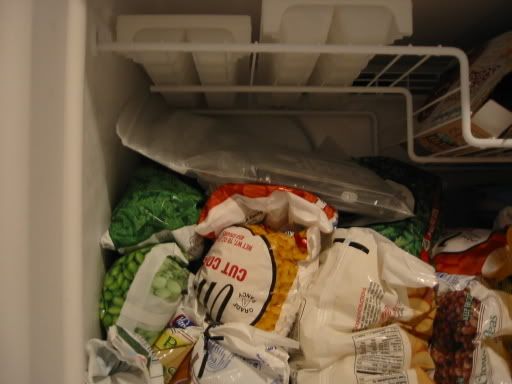
If you Google "freeze hard drive" you'll see that there are a great many people who recommend this for drives that have physically failed. The cold shrinks the metal enough that sometimes a drive will spin that has been having problems. This made a lot of sense to me, especially since I feared that excessive heat had been a contributing factor in the breakdown of the drive. And it's not like I could get into a position that was in some way worse than having a clicking drive that won't boot.
Recommendations for freezer time vary, from 30 minutes to 6 hours or more. I left it in there for about 3 hours while I fixed dinner, ate, and tried not to think about what might be lost.
Moment of Truth
So I plugged in my new external drive, hooked up the necessary stuff to my computer, and got the hard drive out of the freezer. I left it in the ziplocs, opening them just enough to plug in the cables. I left the drive outside of the computer tower, resting it on a blue freezy block (like you put in a cooler) that was wrapped in a light towel.
I turned on the machine. The drive started clicking. I inserted the Knoppix CD into the CD drive, and it booted into Knoppix no problem. But Knoppix couldn't find my hard drive, only the new external drive.
I restarted the machine from within Knoppix. It still couldn't see the hard drive. I shut down.
I had read some suggestions that it was as the drive warmed up from the freezer that it would come to life, so I took it off the freezy block and turned it upside down a couple of times as I turned the machine on, and it stopped clicking and then booted into XP. I was ecstatic. I quickly copied over all the photos that I needed to my USB drive. This took a few minutes -- 5 or 6? maybe 10? Then as I started to look around for a few other files I wanted to save, the drive started clicking again. It felt pretty hot to the touch, so I put it back on the freezy block and put a gel ice pack on top of it. But this didn't work quickly enough to cool it down, and soon the computer wouldn't recognize the drive any longer. I left the ice packs around it and tried booting into Knoppix, but that didn't help.
So I've popped the drive back into the freezer for the night, and I'll try tomorrow to recover a few more files. I don't know how cold our freezer runs, or how many other environmental factors could affect it. (I assume since it's summer here, that the drive will heat up faster than it would in January.) My sense is that the drive has to warm up a bit from freezing, but that it can't get too warm -- sort of a tricky balance. You just get a short window of time, but if you know which files you want to copy off the dead drive, this trick can really help. Knoppix didn't help me, but I can see how it would if the drive weren't so totally dead. (Booting into XP added some wear onto the already weak hard drive that might have been avoided had Knoppix been able to see the drive. Maybe I'll try Knoppix one more time tomorrow, with a slightly thawed drive.)
The Lesson
Well, duh. Back up your stuff. I knew that already. But I'm a fallible, flawed human being who sometimes loses track of the calendar and doesn't always get to everything on the to do list.
The other lesson for me was to go ahead and try something a little drastic, because it wasn't that hard and it actually worked. I got all my pictures!
Sometime Friday evening, the hard drive in my home desktop PC failed, in a major kind of way. In retrospect, I should have realized this was coming -- except that I have never had a drive fail like this before. But my gut was telling me something was wrong with that computer (which is 4 1/2 yrs old). I haven't been using my desktop at home as much lately, ever since I got the laptop. But I prefer to work on it for anything involving graphics, and it has all of my personal files and programs (the laptop is owned by my U and I keep it very streamlined with work materials only). So my awareness of its behaviors was less attuned than it might have been a few months ago, when I was using it daily.
A Little History
A couple of weeks ago, I noticed that the hard drive seemed to be active often even when I wasn't doing anything resource intensive. Of course, I suspected software problems. I ran all my spyware checkers, double checked my antivirus and firewall. I didn't come up with anything. Then one day Windows Explorer, which I use to manage my directories and files, kept freezing up. I Googled the problem, and discovered various possible reasons for it (a conflict with an old printer -- which had never caused the problem before; the need to edit some registry values; etc) . I followed all the recommended steps and my machine still kept freezing up. Finally, I downloaded a shareware filemanager that worked plenty fast (and had features I'd often wished for in Windows Explorer). I was still a bit uneasy about why my WinEx had suddenly started pooping out -- but then a few days later it was back up just as speedy as ever. Weird. And for some reason I never considered that it might be a hardware issue. I blamed the most recent piece of evaluation software I'd put on the machine, and uninstalled it (to no effect). I questioned our home network setup. I knew something was off, but I didn't know enough to know what to look for.
The universe had been sending me some unrecognized signs, though. One in the form of one of my colleagues, who told me all about how one of her hard drives crashed and she lost 400 hours of work. Another was the little nagging voice in my head telling me I ought to do a full backup (which I didn't listen to). And only a couple of weeks ago, I stood in front of an aisle of external hard drives with my GF, who was buying one, and I talked about getting one to simplify my backup strategy. But I felt overwhelmed by the choices, burdened by debt, and I hadn't done any research, so I didn't walk out of the store with a new drive. I put it on the list of things to look into.
The Crash
I used my desktop computer Friday afternoon for a couple of hours. Nothing unusual in sound, behavior, anything. Then I put it to sleep, and went about my day. Around 11 pm, I happened to walk by the door to my study, and saw that the monitor was on. I went in, and it was showing the "hard drive not found" error message. Yikes. I turned the machine off, turned it on again, with no luck. I knew this was bad. I googled around a bit on the laptop to learn what my options might be, and then went to bed.
I got up early today (Sat), walked the dogs, made a lot of coffee, and faced up to the situation. My first task was to check my backups (I've been burning my backups to CDs) and see what I was missing. Most of my work files are pretty well backed up, but I had a lot of photos that weren't. Those were my primary concern, since they couldn't be replaced or reconstructed (the most recent work files and Quicken stuff could be rebuilt from paper documents if necessary).
I made a list of what I wanted to recover from the drive, if possible, and in what order.
I had turned the AC on in that room overnight, concerned that my machine might have overheated (Friday was a warm day, and that room can get quite warm). So I turned it on this morning hoping that all would be well -- and it wasn't. In fact, it was now worse, as I could hear the clicks of death coming from the drive. I quickly shut the machine off, and turned back to Google.
My Action Plan
I knew that going to a professional data recovery place was not an option -- I don't have the money for it, and the files weren't that crucial nor that numerous. I needed to figure out what were the last-ditch things I could try at home. (Bearing in mind that I'm a reasonably skilled computer user, but not someone who messes around under the hood. In fact, I'd never opened up my machine until last fall, when I had to replace the power supply.)
I did some reading around, learned about how hard drives physically fail, and came across various suggestions about what to do. I learned a lot from reading other people's stories, which is why I'm writing all this down, so that it might help someone else eventually.
Based in part on this article, as well as some other references, I decided to go ahead and download Knoppix, a Linux filesystem that boots from CD and can help you recover files from a failing drive. It took me about an hour (my wireless connection with the laptop isn't that fast) to download the ISO file, which I then burned (as an image) to a CD. (After getting a utility to do the recommended checksum -- all very easy to do, but all new to me.)
Then I went out to pick up an external USB drive. I got the basic Maxtor, which lets you just plug it in and use it. Other models and brands had backup utilities and other features which might be great someday, but for this situation I wanted the simplest thing.
Then it was time to disconnect my desktop (which meant pulling down our internet connection), remove the hard drive, put it in three layers of ziploc bags (two regular, one freezer weight) and stick it in the freezer:
If you Google "freeze hard drive" you'll see that there are a great many people who recommend this for drives that have physically failed. The cold shrinks the metal enough that sometimes a drive will spin that has been having problems. This made a lot of sense to me, especially since I feared that excessive heat had been a contributing factor in the breakdown of the drive. And it's not like I could get into a position that was in some way worse than having a clicking drive that won't boot.
Recommendations for freezer time vary, from 30 minutes to 6 hours or more. I left it in there for about 3 hours while I fixed dinner, ate, and tried not to think about what might be lost.
Moment of Truth
So I plugged in my new external drive, hooked up the necessary stuff to my computer, and got the hard drive out of the freezer. I left it in the ziplocs, opening them just enough to plug in the cables. I left the drive outside of the computer tower, resting it on a blue freezy block (like you put in a cooler) that was wrapped in a light towel.
I turned on the machine. The drive started clicking. I inserted the Knoppix CD into the CD drive, and it booted into Knoppix no problem. But Knoppix couldn't find my hard drive, only the new external drive.
I restarted the machine from within Knoppix. It still couldn't see the hard drive. I shut down.
I had read some suggestions that it was as the drive warmed up from the freezer that it would come to life, so I took it off the freezy block and turned it upside down a couple of times as I turned the machine on, and it stopped clicking and then booted into XP. I was ecstatic. I quickly copied over all the photos that I needed to my USB drive. This took a few minutes -- 5 or 6? maybe 10? Then as I started to look around for a few other files I wanted to save, the drive started clicking again. It felt pretty hot to the touch, so I put it back on the freezy block and put a gel ice pack on top of it. But this didn't work quickly enough to cool it down, and soon the computer wouldn't recognize the drive any longer. I left the ice packs around it and tried booting into Knoppix, but that didn't help.
So I've popped the drive back into the freezer for the night, and I'll try tomorrow to recover a few more files. I don't know how cold our freezer runs, or how many other environmental factors could affect it. (I assume since it's summer here, that the drive will heat up faster than it would in January.) My sense is that the drive has to warm up a bit from freezing, but that it can't get too warm -- sort of a tricky balance. You just get a short window of time, but if you know which files you want to copy off the dead drive, this trick can really help. Knoppix didn't help me, but I can see how it would if the drive weren't so totally dead. (Booting into XP added some wear onto the already weak hard drive that might have been avoided had Knoppix been able to see the drive. Maybe I'll try Knoppix one more time tomorrow, with a slightly thawed drive.)
The Lesson
Well, duh. Back up your stuff. I knew that already. But I'm a fallible, flawed human being who sometimes loses track of the calendar and doesn't always get to everything on the to do list.
The other lesson for me was to go ahead and try something a little drastic, because it wasn't that hard and it actually worked. I got all my pictures!
7/28/2006
goal tracking (1 of 2)
I've often benefited from using various tracking systems when I'm trying to improve a behavior. As most people who've ever tried to keep a food journal realize, just the act of writing down everything you eat tends not only to make you more aware of what/when/why you eat, but also improves what you choose since you don't want to have to write down the bad stuff. Writing down exactly how you spend your time for the entire day can have a similar effect. Logging your activities makes you aware of how you're spending your time.
There are different methods for time and goal tracking, some at the planning end (How do you plan to spend your time?) and others at the capture/recording end (How did you actually spend your time?). Different organizational gurus have built entire systems around one set of concerns or the other. I've benefited from both the top down and bottom up approaches, and lately I've been using two different tools that let me do a little of each. (Second post coming up in a day or two.)
One is a handy web application called Joe's Goals. It offers a goal tracking chart somewhat similar to Benjamin Franklin's chart of behavioral guidelines, which let him track his progress throughout his life (although old Ben marked the boxes of the virtues he didn't achieve during the day, kind of a negative approach that most productivity folks wouldn't recommend today -- but over time he eventually saw the marks diminishing on the pages of his chart). Despite the name, I see this tool as an action tracker, not a goal tracker per se -- if you spend some time reflecting on your larger goals (be a productive researcher; improve physical health; etc) and then choose a small number of defined, repeated behaviors that would help you achieve those goals, then you can use this tool to help you chart your progress. (On setting priorities, goals, and actions, I'd recommend Cheryl Richardson, Take Time for Your Life, Jack Canfield & Mark Hanson, The Power of Focus, or Vince Panella, The 26-Hour Day.) The key is figuring out specific actions you want to track (and to know why you are doing this).
You can name both positive or negative behaviors, and mark them off daily as you do them, and the tool tallys up your score for the day. You can now also assign different point values to your goals. On my chart, for instance, I have things like "floss teeth" which is a behavior I'm striving to do every day. But it's only 1 point, whereas "write for 30 minutes" is worth 3, because it's both more important and more difficult. I don't have any negative behaviors (whose points are assigned negative values) on my chart, because I'm all about striving to improve, rather than criticising myself. So, let's say I've been having a not very productive work day. At the very least I can check off yoga, flossing, and taking vitamins, and I know I've made some progress towards my larger goal of improved health.
One of the reasons I've been trying out this tool is that when I completed the Bikram Challenge this spring, my studio had a chart on the wall for each of the participants to mark off as we completed each of the 60 consecutive classes. It sounds silly, but it was very satisfying to see your progress accumulate. Plus, of course, others in the studio were supporting us as they looked at the chart too. The Joe's Goals tool has a feature I haven't tried, which allows you to share your progress on certain goals with others-- this might be useful for a writing group or knitting group etc.
As I've been using the tool, I have definitely found it to have its own motivational pull -- I'll think about doing certain things so that I can have the satisfaction of checking them off. I intentionally listed both personal actions and work-related actions, since all of these behaviors are things I want to encourage in my life. Looking over a week's worth or month's worth of check marks helps me see the larger picture of how I spend my time, and how that relates to who I want to become.
7/26/2006
Reading for Pleasure Wednesday
First, off, if you're not yet aware of RfP Wednesdays, the rules are at Dr Crazy's.
The book I finished most recently is Chimera, by Will Shetterly. Just something I picked up while browsing in my local public library branch. I'm sort of in a lull between hold requests at the library, so I was just picking up a couple of things to tide me over.
This isn't brilliant or innovative SF, but it was a fun and engaging read. It's a hard-boiled detective novel set in a future LA run by Libertarians. The down-on-his-luck detective, Chase Maxwell, gets hired by a mysterious woman...who actually is a jaguar chimera, a human-animal blend, created by gene splicing science. The murder/investigation plot includes all that you'd expect from that genre, but set in a futuristic world with its own set of problems. Chimera rights, AI rights, poverty, workcamps...the setting is ethically and scientifically interesting, and the novel really grew on me as I read it. A quick, quirky read, very self-conscious without being pretentious about the various narrative subgenres it mashes together.
7/22/2006
RBOC, light/lite/lyte edition
- The new Gatorade Rain is actually pretty tasty -- much lighter and less sweet in flavor, though the ingredients and calories and electrolytes and stuff are all the same as the original.
- I am poised to cook something for dinner but in a bit of a quandary as to what it shall be. I had a plan, but then the fresh basil at the store demanded my attention. So now I have to cook something basil-y. (i.e., not veg chili)
- Today was not very productive at all, though I got some social points onto my scoreboard for the month by having coffee with a colleague who is is sort of a lite variety friend, someone I meet for coffee or lunch once or twice a semester.
- I had a great yoga class today. And my ankle is much, much better. Except for some slight swelling after class you wouldn't know it had been injured. I can even do toestand again.
7/21/2006
recently read
Lest you think I have been spending all my summer doing clerical tasks and watching TV shows, a few overdue notes about some novels:
For years, now, I have been resisting various people's recommendations to read the first three novels by Sarah Waters (I even own a copy of one that a former student sent me, convinced I would love it). Because I regularly teach and write about Victorian literature, I tend to avoid historical novels set in the 19th century, for several reasons. My fun reading needs to be fun -- and therefore pretty well distinct from my work life. And historical novels are too distracting if I know anything about the period. I can't just relax into the characters, I'm too busy questioning the setting. But I picked up her latest,The Night Watch, which is set during WWII, a period that I know in a much more casual sort of way. It's a novel in the guise of three novellas, ordered in reverse chronology from 1947 to 1941, which focus on a small group of characters (a butch ambulance driver, a secretary, a writer) whose lives repeatedly intersect. Questions of privacy and secrets run throughout the book, deftly connecting wartime security issues, the press of bodies in bomb shelters, adulterous affairs, and homosexual relationships. The war changed everything, we have been told so many times -- the reverse structure of this novel supports that generalization by making it specific, focused, walking the reader through the actions and choices that made the characters who they have become. It mostly didn't feel gimmicky, although I was a bit disoriented after I'd put the book aside for a few days and then returned. And bits of it were sensitive and well written. Enough so that it might almost make me reconsider whether I should look at her earlier novels.
It was partly accidental that I wound up reading two second novels by young gay novelists within the same week: Karl Soehnlein's You Can Say You Knew Me When and Bart Yates's The Brothers Bishop. When I'd looked up to see if Soehnlein had written anything lately, Amazon also brought up Yates's second. I put the hold requests in to the library, and then somehow they both arrived at the same time. I mention this only because a few years ago, when I read Yates's first book, Leave Myself Behind, I kept thinking about Soehnlein's first, The World of Normal Boys. Both were coming-of-age novels focusing on gay teenage protagonists. Because of the genre, the similarities were striking. And there are some similarities in their second novels, too, broadly speaking. Both focus on relatively unlikeable or unsympathetic narrators, men who are incapable of sustaining romantic relationships, and few platonic ones. Both characters are shaped by their dead fathers, fathers whose rejection still governs their adult lives. And both novels include problematic relationships between adult men and teenage boys.
There are differences, of course, too, and if I hadn't read them one after the other, maybe I wouldn't see the patterns so clearly. Soehnlein's hero discovers some old letters in the attic after his father's death that suggest his father not only spent a year in San Francisco in the 40s, but had gay friends and possibly a gay relationship. Jamie returns to his home in dot-com era SF compelled to research the city's early history and unearth the truth about his father's past. The interweaving of the historical plot and the mess Jamie is making of his own life and relationships is well handled, although Jamie's hysterical unravelling started to wear a bit on me by novel's end. Overall, the novel takes up some key questions about the relationship of Beat writers to SF and to contemporary gay culture, and moves beyond the simple self-discovery paradigm.
Yates's book is much darker, even, than Soehnlein's, as his hero Nathan and his brother Tommy survived a physically and emotionally abusive childhood -- Tommy by becoming the outgoing flirt and Nathan the introvert suffering from suppressed rage. Both are gay, and their complicated bond with each other is the centerpiece of the book. When Tommy brings two friends to stay in Nathan's cottage, he disrupts Nathan's carefully managed personal and professional life. Add a confused teenage student to the mix, and you get a volatile, violent, and yet sometimes surprisingly beautiful book.
Although I recommend them both, I think I liked this book more than Soehnlein's, and the same was true of their first novels -- although in both cases I read Soehnein's before I read Yates's. When they come out with their third books I'll try to read them in reverse order, and not so close upon each other.
Friday is the best day
For some time now, GF and I have made it a tradition to take Friday as our day off together. Sometimes university duties will intervene, but I no longer ever have to teach on Fridays and rarely have Friday committee meetings more than once a month. One of the advantages about working at an urban campus is that the faculty live spread out all over the city and suburbs, and no one wants to drive in more than three or four days a week if they can help it. And anyway, it's the summer now, so my Fridays have been clear. (I should note that GF and I both work on Sat and Sun, so it's not like we're total slackers. )
We always start Friday by sleeping late, without setting the alarm clock. Then we have breakfast and take the dogs to the park (sometimes stopping by the bagel shop on the way to the park, for an extra special treat). After the park, we take the dogs home, and then usually go out to lunch. Maybe a trip to the public library or a matinee movie, sometimes coffee out at Starbucks. It's great to have a day that we've set aside just for spending time together, not filled with chores or errands or work.
The past couple of Fridays we've started a new pattern, picking up take-out food on the way home from the park, and then hanging out on the couch and watching an episode of Battlestar Galactica, which we're currently watching on DVD from Netflix. I almost never watch TV or movies at home during the day, unless I'm sick -- it makes me feel sort of depressed or icky (although going out for a matinee doesn't). But this has been a fun twist on our usual routine, and especially nice when it's hot and you don't feel like running around so much. It feels like playing hooky, which is really the main theme of our Fridays -- taking a day off when other people are all at work.
I've been totally loving BSG, too. Starbuck as a woman is awesome -- and as close to a butch hottie I'm ever going to get to see on TV. (Although the last episode just showed her in a formal dress, which dashed my view somewhat.) The mix of action, politics, and intrigue seems just about right in most episodes. We're only toward the end of season one, and I'm already feeling sad that we'll run out of disks soon. That's the only problem with watching shows on DVD, waiting another year before they come out. GF keeps reminding me that there are other shows and movies waiting to be watched, and it's true that I have 187 in my queue. But they won't be BSG. And a good thing about watching this show, as opposed to all the other ones we're currently watching (this is the summer of TV on DVD for us -- seeing all these cable shows we wouldn't get to watch otherwise) is that Commander Adama looks a lot like one of my academic mentors. So I watch the show and then I start feeling like I should do some work. Or send him an email. Or prove myself somehow. And that's not a bad thing, even on my day off. It gets me feeling motivated for tomorrow.
For the rest of today? Blogs, maybe some fun reading, a trip to the gym. Maybe I'll start playing the computer game I got for my birthday. There's a lot of stuff in the "should" pile -- the leaky faucet to fix, the files to continue purging, the pants to hem -- but today is Friday, for frack's sake. All that stuff can wait til tomorrow.
7/19/2006
clerical skills
Dr Crazy recently wrote about the fact that she, like most academics, has to function as her own secretary. This is something I've been thinking about a lot, especially now that I've had an administrative post for a year. There is a tremendous amount of clerical labor involved in academe, and a number of factors have shifted much of that labor to faculty, at least in some institutions. (Mine is probably more like Dr Crazy's, where faculty do their own copying, filing, etc, than New Kid's, where they have some staff support).
Technology has dramatically changed the workplace landscape in all professions, "allowing" (and therefore often requiring) professionals to handle much of their own correspondence (especially with the widespread use of email rather than paper) and to create presentable versions of written documents. These tasks used to take up a lot of time and energy from support staff. Other secretarial duties, like managing appointments and fielding phone calls, are still sometimes taken care of by assistants depending on the workplace situation (i.e.,doctor's offices, high-level execs; in my own institution, Deans and some Chairs have secretaries who can set appointments), but many professionals now manage their own calendars. The growth of productivity solutions, self-help paradigms, and so forth helps us do all of these tasks, and possibly achieve better focus, better outcomes -- but also there is a tendency to make a virtue out of necessity in all this. I myself can't imagine having anyone else messing with my filing system, my calendar, or my email -- it would be an invasion of privacy, among other things. But if I had never handled all these things myself, maybe I'd feel differently.
Writing has changed, too. I'm old enough to remember watching my parents literally cutting up paragraphs from a typescript draft and taping them on new sheets of paper to rearrange blocks of text. When you had to type each draft yourself, or hire someone to do it, it meant that each draft was a much more final and stable state than what many of us produce today. Our expectations for well-crafted prose have increased, as have our expectations throughout academia for what a presentable document looks like. This is labor that we've absorbed into our ideas about the writing process, not always to our benefit. I went off to college with a new electric typewriter (a big step up from the manual I'd learned on and had been using in high school) . Until graduate school, my course papers were written out in longhand draft, revised once or twice, and then typed. There was a finality to the revisions -- once I was in the typing stage, I couldn't change anything more than the occasional word here or there, without having to go back and retype earlier pages. That was definitely late night labor you didn't want to repeat. But I always found the typing stage sort of soothing, too, because it meant that the hard work of writing was over. That's never true for me today.
I suspect academia tolerates Luddites more generously than other professions or workplace situations. In my Department (as in most) we have a handful of faculty who refuse to use email, or who refuse to use a computer at all. They are the extreme, but I have been amazed at the number of faculty who claim not to know how to put a ream of paper in the printer, or into the copier. (And then of course there's the guy who can't even use the microwave properly, but he's a Special Genius.) The stereotype of the absent-minded professor lets people get away with all kinds of crap. But really, it's sexism. Because these faculty are old men, the female support staff coddle them -- the older ones because they were trained that way, and the younger ones because they are intimidated. Female faculty, and the younger faculty, tend to be more aware of the constraints on the support staff, more sympathetic to them, and less likely to ask them to do things that are not in their job description. The overworked secretaries in my department are not there to support the faculty. They are there to answer phones, direct students, and manage the accounting paperwork generated by the bureaucracy. But some faculty get special treatment because they are so old or so rude.
Is it good to be clerically competent? I took two years of typing (on manual typewriters! with carbon paper! and erasers!) in high school, which was the best thing I ever did vocationally. I have worked as a secretary in several hospitals and business offices. I have also done freelance typing, data entry, and transcription. I am comfortable working with spreadsheets, with complex tables and layout designs, and can learn my way around any new office software very easily. In fact, my clerical skills outstrip those of most of our support staff. All of this has definitely assisted me in my own career. Formatting a document to meet a new journal's standards is no problem. Making a table with the results from our latest instructional effectiveness survey is easy. If I'm going to be my own secretary, then I'll be a good one. Some of my colleagues have, I think, deliberately chosen incompetence, preferring to have to ask for help. It seems to have worked for a few of them, but I think it's a risky bet. Do you really want the appearance and organization of your tenure notebook to be left up to the cell-chatting work-study student who comes in for a couple of hours on Tuesdays?
7/18/2006
ruwuzidn
I've been a reader as long as I can remember. In fact, some of my strongest early childhood memories are of the books I read, specific words I associate with certain books, even the couch I sat on.
Not only do I enjoy reading, but I've made reading my professional business, too. So I read a lot. But I've never thought of myself as a particularly compulsive reader, one of those people who says they would read the cereal box if stranded without a text.
But apparently I have more of such compulsions than I'd realized. Because when those darn captcha word verification blocks show up on the blogs I comment on, I puzzle over them. Some of that is my limited graphical recognition ability -- the squished-up Vs look to me like Us and I often am asked to re-verify my identity with another nonsense word. But I just now was faced with ruwuzidn and couldn't help trying to read it as if it were a vanity license plate: Are You Wazzup Dean? Are You What's Hidden? Are You Woozy Down?
I once lived in a state which offered vanity plates at an extremely low price, so that everywhere you looked you were faced with these puzzling word games. But at least you could usually assume that there was a meaning in there somewhere.
What do you suppose is the cumulative subliminal effect of being forced to read and reproduce strings of nonsense many times a day?
7/17/2006
Pandora
Am I the last person to have discovered Pandora? It's an outgrowth of the Music Genome Project, which tries to map the universe of music by charting various aspects of particular songs (and artists' oeuvres). You go to the site, set up a free account, and type in an artist's name or two. It creates a streaming radio station with songs by that artist and others the database predicts you will like. As you're listening, you can vote thumbs up or down on a particular song, which further refines the stream you're listening to. In concept, it's a little bit like MoodLogic, which I've been playing around with on my home computer. MoodLogic creates mixes from your own digital collection based on mood and genre preferences you select -- its data is collected from users who've answered questions about how particular songs make them feel. Pandora, however, is built from songs not on your own computer, so you're likely to get introduced to something you haven't heard before. I was able to create an excellent "getting things done" stream based on a couple of artist names -- the ones I usually play over and over when I'm working at the cafe, for instance. Way more interesting to be exposed to some new stuff as well as the familiar. Plus, you can share your streams with friends or post them to your blog...
7/15/2006
three minute forecast
Today's emotional weather: mostly mild, but with intermittent bursts of anxiety, irritation, and jealousy. In three minutes I will need to leave the house to get to yoga, which it's CLEAR that I need. Desperately.
Anxiety count: calendar stress, work stress, and blog insecurity are all high; slight social anxiety expected later in the day.
Irritation count: Moderate to high levels of self-criticism, plus slight amounts of irritation likely caused by household chores.
Jealousy count: Surprisingly high, though it's a passing storm. Someone else's life improving in the way I wish mine would should just be a kick in the ass to work harder, right?
7/13/2006
summertime committee
I've had to put the file sorting on hold for a couple of days -- GF had Monday off, and we declared it a holiday, since we'd both been working over the usual weekend and hadn't really seen much of each other. We've been really enjoying this summer, making an effort to take days off together. We don't have the money or scheduling flexibility for travel, but we enjoy these one-day vacations, especially when they're on a weekday, or semi-spontaneous.
And then I've been busy on campus because I'm on a job search committee for an upper-level administrator position. The committee was formed during the regular semester, but for various reasons the actual work has wound up being during the summer. Which is sort of irritating, but also kind of good, since it gets it out of the way before the fall term starts. Administrators (and there are several on the committee) don't have the same mentality about protecting their summer time that faculty do.
I'm on this committee as the diversity member (because I'm female and in the humanities), not because of any particular expertise. The first few meetings were mind-numbingly dull and not particularly enjoyable. But as we've been accomplishing the tasks charged to the committee, I've grown to like some of the people I've been working with, and I think it's mutual. Getting to know faculty in other units and administrators from across the campus is why I say yes to university-level service (plus, when certain people high up in Administration ask you to do something, you really don't say no unless you have a McArthur grant or a Pulitzer prize). The danger, of course, is that now a few more people have learned that I'm reasonably sane (as well as tenured and female) -- I've already been asked to participate in two new initiatives from the Dean's office. (One I said no to, the other I'm considering.)
I don't mind serving on committees when it actually accomplishes something. I don't mind helping out with projects that seem beneficial to the department or college. Service can be a drain on faculty time and energy, but without faculty participation in decision making, the campus would be entirely run by the suits, which is never a good thing.
7/10/2006
history in the files
I made some good progress yesterday in weeding out my filing cabinets at home. I started with a drawer of files from some of the first articles and conference papers I ever wrote, figuring that older stuff would be easier to sort through. It was, especially since I now feel pretty distant from those essays. There's a small amount of material to keep and file into my reference collection, and a few things that I archive (contracts for publication, correspondence with editors, etc). But there's a lot that can be dumped in the recycling bin. I no longer need any hard copies of drafts, edits, etc. (I did check and I have electronic copies of all of these papers, should I ever for some reason need them).
Obviously, a lot of this material could have been (and should have been) recycled two or three moves ago. But I'm beginning to see that sorting through papers takes a kind of attention and energy that I never have when I'm packing for a move. Or, I could have weeded these out when I got tenure. But at that time, I still felt too close to my past, too close to my graduate school training, too close to the dissertation research that in part helped me get tenure. Now, I'm feeling like I have more distance psychologically and intellectually, so I can better assess what I really need to keep.
One of the interesting things along the way was realizing in a very material way how much technology has changed the way I work, and the way the profession as a whole functions. There were all of these letters in these files -- little typed notes with brief questions or remarks, friendly correspondence from one of my mentors, notifications of acceptance to a conference etc. All of which today would be done on email. I might as well have been looking at an archive from the 1950s. It was kind of startling how dated my own career suddenly looked. Best find: a letter from my mentor from 1991 asking if I had tried email, and saying "it is a very convenient way to communicate." (And yes, 1991 was the first time I got an email account. Using Pine. Ah, those were the days.)
Another realization: I used to write really, really small. I was shocked to see some of these pages of handwritten notes. I guess that was in part a carryover from undergraduate days in the classroom taking lecture notes. I remember that I used to only buy extra-fine point pens. But now, it looks like someone else wrote those notes. I can't write that small any more. Partly because then I can't read it. (And lately I've been buying not just medium point, but bold point pens for certain kinds of notes.)
I'm actually getting rid of some of these notes, the ones on texts or topics I really don't see myself ever revisiting. Or if I do, I'll have to re-read the text anyway, and create new notes, so why bother. Especially these cramped, hard to read notes. I'm trying to be realistic about my work habits and note-taking habits, although that's hard to do. The reality is that most of the notes I take, are taken for a particular project, with particular questions or problems in mind. Which means that they are of only limited use for other projects. I'm trying to embrace the recursiveness of text-based research -- the truth that when I re-read a text (primary or secondary) I see new things. That is a good thing, rather than an indicator of time wasted. I think I've often been frustrated at having to re-read things, but I need to just accept it as part of the process. Or my process, anyway.
I have more thoughts brewing about notes and note-taking systems, but for now I'm going to relish the feeling of lightening my file drawers, which is making real and psychic space for my new projects, the scholar I am today, rather than the person I was so many years ago.
7/08/2006
attic update
Remember those critters in the attic? My GF climbed up there several times (which involves getting the huge ladder from the garage and shimmying through a small hole in the ceiling-- kind of a production) and shone a flashlight around, with no luck seeing any animals. But she also didn't see piles of poop, or obvious destruction, so that was some relief. Things quieted down a lot for those couple of days, so we put the big ladder away.
And then after a few days, we started hearing noises again. Sometimes it sounds like they're bowling above our heads -- you can hear things rolling around. (The attic is unfinished, with lots of little spaces for hiding. Nothing is stored up there. Because of the way the house was added on to, there's two levels to the roof, and all kinds of crawl space.) Oddly, though, the noises have to be really loud for the dogs to notice. The dogs are much more anxious about critters in the yard, or under the house. Several times I've noticed Speedy (who's really the hunter of the pack) peering up intently at one corner of the house at night, but I've never been able to see anything, until two mornings ago. Speedy got me up at 5:30 asking to go out and pee (which is not unusual for her). But what she really wanted to do was go out and sniff and look up at that corner.
Now, usually, Speedy gets so worked up about whatever she's looking at, she winds up barking loudly and scaring it off (squirrels etc). But she was really intent and quivering. So I joined her and stood for a long while in the yard, looking up at the neighbor's tree which practically touches our roof. Finally I was rewarded by seeing a little masked bandit face! That's right, a raccoon. She was just sitting in the tree, I think eating some berries from it. Then something small and super fast (I'm guessing this was one of her babies) rushed past us on top of our fence and jumped up into the tree with mama. The thrashing of the tree branches was too much for Speedy, who started barking, and I saw mama raccoon lumbering across my neighbor's roof to the big tree in our front yard. I couldn't see stripes on her tail, but her face was masked so I'm pretty sure she's a raccoon. Certainly not a possum.
The good news? once the babies are weaned, they'll likely all leave the attic. Then we have to try and figure out their entryway and block it up. The other repellent suggestions I've read have been pretty easy and nontoxic to try -- natural orange spray, cayenne pepper, talk radios. GF's going up there probably scared them away for a little while, because they don't like light or noise. And, luckily for us, raccoons don't eat in their den. There's no food they're getting from our attic or around the house (our trash bin has been unmolested, and the dogs eat inside). So they're just playing and sleeping up there.
We still have wild creatures in our attic, but somehow knowing what they are is comforting.
progress
Today I was able to do the entire class at my mat, without needing the balancing barre! This is a huge step and makes me feel more like I'm fully practicing. My ankle still has a ways to go to gain back my usual level of strength and balance, but I'm definitely getting better.
7/07/2006
files
It's summer time, so I'm in the midst of several re/organizing ventures. When I moved last summer, to both a new house and a new office, I thought I'd sort through my files at that time. But then reality kicked in, and it was easier to simply pack them up and throw them back in the filing cabinet when the move was done. I had so much else to sort through that I never got around to the mega purge I'd planned in my mind. So now, this is the time.
One of the organizational areas that I actually feel really good about is my paper filing system. I'm not always great about putting folders back in the drawers, but I know where they should go and can easily find things (provided that I put them back in the drawer). But I haven't substantially changed it since graduate school, and I figured it was time to weed out some things and possibly alter some filing categories. For instance, "Dissertation Files" (as separate from "General Subjects") which then became "Book Files," can now be weeded out or folded into my general reference drawer as appropriate. And there's a lot of stuff that I used to keep paper copies of that I no longer need to because it's readily available digitally -- I'd rather save PDFs for journal articles, for instance, than paper copies.
I use plain manila folders, third-tab cut, but I don't worry about which tab comes next in the drawer. No hanging folders -- they take up space and would confound my system. Color folders sometimes seem appealing, but I would have difficulty assigning colors to particular categories and then worrying about running out, etc. (And having just random colors would not work, at all.) I occasionally will pick up a blue or red folder from work to use for Things That Must Be Mailed Today or some such hot folder. But I'd never file the bulk of my work in colors.
I'm sticking with my basic system, which is subdivided into the big categories of Professional and Personal, with a few subcategories within each, and A-Z filed within those. David Allen advocates one single A-Z file, but that's not how my mind works. If I need my glasses prescription, I know to look in the Personal/Health section. And my research files have to be divided into several categories (by type of material, and by project). It's all just a question of figuring out how you plan to use your files. But I've rarely met academics who didn't already have pretty good filing systems in place (whether or not they actually put the papers away). How can you get through a dissertation without one? If you feel you need a tune-up, Julie Morganstern has good advice on files, and so does Allen.
But I finally gave in and bought a label maker (an inexpensive Dymo Letratag), per David Allen's instructions. That's my incentive for working on this overhaul, to see nicely labeled folders fillling my cabinet. And he's right. Your folders really do look better with a clear printed label on them. Your ideas look better. And, for the moment at least, it makes filing seem more fun.
7/06/2006
from the mat
Looking for some positive spin on the sprained ankle, I thought today after class how having an injury is sometimes a good path back to beginner's mind. Right now, I'm wearing a brace in class, and I have to do the one-legged poses at the barre in the back of the room. I'm usually one of those front-row people, the ones who get there early to soak in the heat for 20 minutes before class starts. But since I have to go to the barre for part of class, I'm standing in the back, where you can't see your whole body in the mirror, where you are surrounded by the newer students who are struggling. And, I should note, I'm struggling too, forced to reconsider the basic dynamics of the moves. I'm newly aware of the relationship between my hip bones and my feet, the way the knee does or does not communicate between them. The poses demand all my attention, a focus that is less meditative, more precise than my usual mental state during class. More like the experience of being a beginner. My left ankle is a beginner, just starting to figure out how to last through half the class, shrinking from certain poses, stumbling through others. Right ankle, on the other hand, is an advanced student, who sometimes can't help but show off a bit. But they're both in the same class, doing the same moves. I am my ankle. Both of them.
7/05/2006
social event
My GF and I were invited and actually attended a 4th of July party yesterday. This wouldn't be shocking news for most people, but for hermits like us, it is. It helped, of course, that the hosts (and guests) were not connected to our jobs, or families, so the irritation factor and social-reputation stakes were pretty low.
I'd just read Nicolas Boothman's
How To Make People Like You, which is a quick primer on basic communication skills, drawing in places on some of the early NLP research. NLP (think Tony Robbins) is kind of interesting, if controversial (and, like any communication skill, easy to use either for Good or Evil). Boothman's book (which I'd gotten at the library after reading about it on someone's blog) starts with basic protocols for introducing yourself (remembering to make eye contact and smile are things that seem really obvious, but are sometimes difficult for me). Then there's information about synchronizing yourself with the person you're talking to -- which most of us do anyway, instinctively, with people we know or like already -- you tend to match your posture, tone, rhythm, etc. He suggests that people primarily process information through visual, auditory, or kinesthetic methods,and that paying attention to the word choice someone uses can help you communicate appropriately (i.e., the difference between "I see what you mean" and "I hear what you're saying"). Finally, there's a fascinating section on eye movements and their relationship to the brain's processing of memory -- within the scope of his book, you simply learn to observe people's eyes to understand them better.
So I approached the party as a chance to try out some of Boothman's tips. I wasn't consciously doing it most of the time, but I do think that I had an easier time chatting with strangers than I usually would. If nothing else, the book reminded me of some things I already know about communication -- things that in the right setting I already do. And having read his book makes all the small human interactions of the day (greeting the barista, the secretary, etc) a little more interesting, as a chance to try out this new system of information and possibly have a better interaction.
7/03/2006
the brain-ankle connection
Today was the third yoga class I've attended in as many days -- I have to modify a few poses (i.e., I do bridge instead of floor bow, and use the barre for all one-legged balancing poses) but I'm SO HAPPY to be back in class. And I think it's been helping to strengthen my ankle and improve circulation etc. But best of all, I'm not feeling quite so depressed. I really need exercise just to function in a moderately intelligent way. Tomorrow morning I'll try some dog walks (my GF has been patiently doing double duty the past week). It'll be a while before I can stand on my toes or lift heavy weights, but I'm making progress.
maybe eventually I'll even come up with a real topic for a blog post.
maybe eventually I'll even come up with a real topic for a blog post.
7/01/2006
Streep week
A Prairie Home Companion was a really pleasant surprise for me. You see, I grew up in the Midwest. I left the Midwest. And I just can't be ironic about it. Nor nostalgic. So I've never understood the appeal of Garrison Keillor's radio show -- never quite could get which of those two options it was supposed to be. And all that old-timey stuff -- the biscuit jingles etc-- is like an Antique Shoppe filled with collectible Norman Rockwell salt shakers. I understand that some people find it appealing or cute or possibly could camp it up so much as to be Pop Kitsch, but it just makes me want to run quickly in the opposite direction. So I was NOT planning on seeing Altman's latest, even though it was Altman. But my friend was visiting and really, really wanted to see it, and since I had sprained my ankle I felt bad that she was just sitting around and talking with me on the couch, so we went. And I thoroughly enjoyed it. Lily Tomlin and Meryl Streep were fabulous, John O'Reilly and Woody Harrelson too. Streep was perfect as Yolanda Johnson, half of a singing sister act -- she would draw you in, but then you'd see in the next moment how her weak boundaries between stage and life were clearly a problem for her depressed and sullen daughter (Lindsay Lohan) who resents her mother's vapid stubborness and performative charm. I surely overidentified with Lohan's character (having a theatrical mother myself), but I thought that their scenes were really well done.
The ending felt kind of tacked on, and the mumbled bit about Lohan's getting her mother to sign away her power of attorney seemed an unnecessary and overdone jab about the greedy younger generations -- especially after the daughter's performing on stage. I know it was probably meant as a contrasting flavor to lessen the sweetness, but it didn't seem at all consistent. Tommy Lee Jones as the representative of the evil corporation who's buying out the radio show folks was enough. Because the real battles in the film aren't with competitors, but with time itself, and death.
And then yesterday we went to see The Devil Wears Prada, in which Streep shines as Miranda Priestly, the Fashionable Boss from Hell. There's a scene late in the film where her assistant Andy comes upon her unexpectedly, wearing a bathrobe and without styled hair or any makeup on -- the entire audience gasped at the sight, so convincing was the character as someone who controls surfaces to her advantage. Although there's campy moments in the film (how could there not be), Streep doesn't just play it for drag -- there's pathos underneath.
And I love the casting of Anne Hathaway for the role of Andy, the heroine of the story (and no, I haven't read the book so I can't compare it) -- a wonderful intertextual move given her role in The Princess Diaries. Both stories are about fairy-tale transformations, from awkward ugly duckling into beautiful swan, complete with sympathetically embarassing mistakes, makeover scenes, and amazing dresses. Andy is told several times that "there are thousands of girls who would kill to have your job," in a media culture where Vogue is something like a royal family and many girls are willing to try on the glass slipper. Even if you don't follow fashion, you too are nonetheless pushed around by the Fashion Cartel, who decree which colors are in. A fairy tale for the postmodern age, the film lets us both indulge in fashionable fantasies even while Andy (and the film) thinks they're kind of silly, and have our morals satisfied, since Andy's makeover comes at a Faustian bargain price, and she eventually has to renounce it all to become Lois Lane. Yes, it's predictable, but it's a lot of fun.
6/29/2006
what I have learned
- If I didn't exercise, I would have a lot more time.
- But if I didn't exercise, I would have to spend a lot of that time being depressed.
Today was day 6 on restricted activity because of my f*n sprained ankle. It's getting better, but I have to be careful not to overdo it -- this is my bad ankle that was injured years ago and has never been the same since. I know from experience that waiting until it's really healed is important so that I don't reinjure it right away.
I'm used to getting a certain amount of activity every day, and it's an important element in my brain chemistry management plan. Not getting it is starting to really get me down. I can do some very modest yoga and stretch, but even the minimal amount of walking I've beeing doing (parking lot to office, etc) gets my ankle really tired by day's end.
Each night I've been surprised by how long the evening is after I come home from campus -- I usually have 2-3 hours of transit time and yoga and/or gym in between. So it's been nice to do some reading and hang out with the dogs. But not nice enough that I'd trade if given the choice.
6/26/2006
Intuition
I recently finished Allegra Goodman's newest novel, Intuition, which focuses on the work and lives of medical researchers in a Boston area research lab. It's a rather philosophical novel in its concerns and its structure, probing into questions about ethics and epistemology. Did the marginalized postdoc Cliff, doing a failed experiment for the third time (against the orders of his supervisor), really discover something that will aid in the fight against cancer? Or did he falsify his results in some way? Goodman cleverly organizes her chapters, which take up different characters' points of view, so that the reader never gets a definite answer to such questions. Instead, we are inevitably in the position of using our readerly intuition to interpret or predict the actions and motivations of the different characters: the two supervising scientists, their assorted postdocs and techs, the spouses and children whose lives are dominated by the pursuit of medical discoveries.
Unfortunately, the word intuition shows up rather too often in the book's midsection for my liking, making what would otherwise be a rather elegant structure seem a bit clunky. Of course, intuition isn't scientific -- we are told this over and over again. In some ways, the novel seems to be interested in revealing the limitations of the scientific mindset (particularly in the scientists' difficulties with human relationships), but the camps of Science and Humanism seem too exaggerated: on one side, the postdocs suffering for their love of research, the research scientist who never sees his family on holidays because he's in the lab, the chess player who can't imagine a world without rules; on the other, an English professor spouse who has never finished her book about suffering poets, and a gawky teenager who shuts herself up in her room reading John Donne and sends copies of Victorian novels to the postdoc she has a crush on. But these are tensions worth exploring, and some of what I enjoyed in the book was its juxtaposition of different models of knowledge.
The last third of the novel sets these issues aside, however, to castigate all outsiders as inadequate judges of what takes place within the confines of the lab: the NIH committee investigating fraud, the unscrupulous journalists, the hayseed Congressman. But the hierarchies of academe and the desire for reputation are equally under scrutiny in this book, which doesn't really offer much of a conclusion. Everyone, from the disillusioned whistleblower to the possible cheater, just wants to keep on doing research.
I always read novels featuring academics, and it's refreshing to read one that is serious, rather than a satire. I thought a lot while reading it about my friends from graduate school who were in biology, and our many conversations about the different processes of investigation and analysis in our respective fields. We in the humanities think differently about the answers and about the questions than many in the sciences, and what we understand as the work of research is often quite different. If just for the depiction of labwork in all its boredom and brutality, the novel is interesting (although hard to read in places). But I wanted more from the characters -- the coldly patterned structure didn't quite give me the intellectual or emotional satisfaction I wanted as a reader.
Subscribe to:
Comment Feed (RSS)