3/30/2006

Bikram questions answered

KF at Planned Obsolescence, who is currently taking yogalates (Yoga plus pilates) classes, is thinking about trying Bikram. She wrote recently:
There’s a Bikram yoga studio just a few blocks from my condo, and I’m seriously considering going there to check it out when I get home. But I’m got certain kinds of anxieties about Bikram, anxieties that I could stand to have dispelled before I go forward with this. Mostly these concerns have to do with the heat: while the studio I’m now attending is heated, class temperatures generally fall somewhere between 80 and 90 degrees, I think, and I can definitely tell the difference between hotter days and less hot days, and between hotter areas of the room and less hot spots. Generally speaking, hotter = more mashed-potatolike feeling at end of class. So this is why I’m concerned: the Bikram place near me says that its studio is heated to 100 degrees, and that’s a hefty number more degrees. Will there be nausea? Danger of passing out? Brain-deadness?

These are good questions, the questions most people have before trying hot yoga. How hot is it really, and will I die? Most Bikram studios are heated to 105 degrees, and humidified to about 40% humidity. The precision with which these conditions are reached depends in large part on the climate of your area (esp with the humidity-- classes in Florida are going to be much more humid than those in Arizona).

Yes, it is hot. You are going to sweat. A lot. Possibly more than you thought you could. It's actually good for you to sweat -- it helps detoxify the body and it is essential to your body's cooling system. Sweat will be running down your face, down your neck, off your fingertips, etc. You don't want to wipe away the sweat during class, not only because it's distracting, but also because leaving it on your skin helps your body regulate its internal temperature.

Every Bikram practitioner has experienced moments during a class when s/he feels pretty awful. As your body is adjusting to the heat and detoxifying, you might occasionally feel a little nausea or dizziness. When that happens, you stand still, kneel down (if the class is doing standing poses) or lie down in savasana. When you feel better, you rejoin the class. During your first class, your main goal is to stay in the heated room. Even if you were just lying down for most of the class and focusing on your breath, you would be gaining health benefits. All certified Bikram instructors repeat these instructions to their students at the beginning of class, and no one is ever asked to do a pose if they feel bad. If you feel bad, you lie still until it passes.

The good news is that even the worst sensations pass fairly quickly. And many students don't feel that way at first -- it might be much further on in your practice, and then you suddenly have a struggling class. Every day is different. This yoga teaches you to be very aware of your body, of how much you slept, what you ate, etc.

There are also some things you can do to make your first few Bikram classes easier:
  1. Really, really hydrate yourself for the whole day before class (this is one reason I don't recommend doing a super-early class at first, since most of us don't drink water while we sleep). I aim to drink at least 2 liters of water during the day, 3 or more if the weather is hot, before going to class in the evening.
  2. Add an electrolyte supplement to some of that water an hour or so before class: a packet of Emergen-C, or ElectroMix (both made by Alacer) is especially helpful, and doesn't have all the sugar of Gatorade. But Gatorade is available at every minimart and drugstore. So if that's what you've got, drink some.
  3. Plan your eating. The conventional advice is not to eat for 2 hours before class. I think that's true if you have normal blood sugar, a sensitive stomach, and if "eating" means heavy food (a full meal, or meat & fat). For myself -- a vegan with low blood sugar issues -- it's actually important for me to eat a little snack fairly close to class time. Class is 90 minutes long and if my blood sugar is too low heading into it, I'll feel sick. So I eat a banana and some soy milk, or part of a Clif bar, something like that, 30-60 minutes before class. But I wouldn't eat anything that requires significant digestion (broccoli, even brown rice) since you want your stomach to be ready to move. You know already how sensitive your stomach tends to be, and how your blood sugar is. Don't be afraid to tinker a little bit with the conventional recommendations if it works for you. Most people can handle a little fruit before class, and it can help a lot with the lightheadedness in the heat. Bananas and oranges are especially useful for the potassium.
  4. You'll want to have a liter of water with you in class -- most studios sell water there, but I recommend if you can, to prepare your bottle ahead of time. Freeze a bottle that's half full and then add water to that. You want about half ice, half water -- this will keep your water chilled during the class.
  5. Don't gulp water -- sip it very judiciously during the water breaks (which occur at set intervals in class). Gulping (esp if it's iced) will make your stomach cramp. The water in class is really for your mind more than your body -- it takes 20-30 minutes for water to be absorbed into your body, so the water you drink during class isn't enough to compensate for what you're sweating out. That's why you have to drink a lot beforehand.
  6. If you're suffering from the heat, splash some of your water on your neck or on the back of your head during the water break. It's way more refreshing than drinking it!
I love this yoga, and I have experienced first-hand the health benefits that result from regular practice. This system of yoga was designed to heal injuries, improve your alignment, improve the health of your internal organs, and balance the nervous system. It is challenging, no doubt about it. But the effort you put into the yoga is more than repaid in the benefits.

More Bikram questions, anyone?

vs recommendation letters

I'm trying to understand a justifiable rationale for requiring recommendation letters for faculty applying for small grants in the humanities. (as an aside: when scientists apply for grants do they need rec letters?)

I'm not talking about the writing of rec letters for students getting into school, for grad students on the job market, or even for faculty hiring in general, although there are problems in all of those areas too. We all have read (and possibly written) letters that were clearly dashed off in a hurry, written out of a sense of obligation rather than enthusiasm, or simply to get a person out of your office. I mean, really. The most absurd/pathetic applicants for our recent faculty positions (and I'm talking here about people without PhDs, or with degrees in fields not remotely connected to the job, or people whose personal pathologies were visible all over their cover letters) -- all of these people still somehow managed to shake the bushes and get a positive recommendation letter from somebody. Which in and of itself casts some question on the usefulness of the letters. But when you are hiring someone to a faculty line, or accepting someone into your grad program -- you are entering into a longterm relationship with the person. So the idea of getting a letter from someone who actually has met and known the person has some validity, and yes, sometimes the letters can tell you things (like about someone's teaching) that you can't see elsewhere in the file.

But why require letters for small grant programs? (Small in this context means $250- $5,000 -- amounts that most of the scientists I know would sneeze at but which could go a long way in xeroxing money, microfilm money, travel to libraries.) The granting institution/agency isn't going to ever meet the awardee in person. Yes, their name will be attached to published work deriving from the grant period -- but to find out whether someone is a successful published scholar in their field, you have only to look at the cv. The cv lets you know how efficient someone is in getting their work out. The project description gives you plenty of information about the content and significance of the work. It seems to me that letters let the grant committees off the hook of actually having to know anything about the grant field.

More insidiously, the practice of requiring such grant letters reinforces the conservatism and elitism of academe. People with connections to big-name letter writers (who generally came out of top rank programs) get more awards than people without such connections. People in defined conventional areas of study get more awards than people in newer interdisciplinary areas. There's also tremendous unstated workload for those people in positions of power who are asked to write such letters. Their agreement or decline (or delay) serves as a hidden gatekeeping function for The System. The result is that those who have, get more. And those who don't, struggle.

3/25/2006

shaping graduate students

I've been thinking a lot lately about how one learns to be a graduate student. I've been rather frustrated with my grad class this term -- I'm afraid it's been really a rather mediocre experience. My students are nice enough, and some of them are bright. But they're just not doing the work, or doing it in the ways that I expect from graduate students.

At the institution where I did my Master's, it was common practice for faculty to hand out lists of secondary readings that were not on the syllabus, not exactly required reading -- but we were expected to read at least some of that material. Those lists were a set of critical signposts, some help with navigating the topics.

At the institution where I did my PhD, it was assumed that we had the skills to come up with our own lists of critical material. It was expected that you did the assigned reading for class, the extra research for your presentations and essays, and additional critical reading just to learn more about the topic. And, too, in order to not feel stupid in class discussion. Yes, it was a competitive culture that had many dark sides. But to be in a room of smart people who are trying to show off how much they've read about a text? Not that terrible a thing. The showing off could be tiresome, but we all did a lot of work, and it paid off.

Now, the department in which I teach is nothing like either of my graduate institutions. We are far from top tier, and our students are a motley bunch. Some are using our MA as a stepping stone to a better PhD program; others need to stay in this region for family or work reasons and need the credentials. Others are pursuing the PhD in order to teach at junior colleges. A small number of our best students get jobs at 4-year teaching colleges. But almost none of them are heading towards a research-intensive career.

Our students aren't professionalized when they arrive, and the culture in the department doesn't seem to be doing a good enough job of it. The graduate student association sometimes holds orientation sessions, and the faculty offer sessions on professional topics like preparing conference abstracts or getting ready for the job market. But no one is telling them how to behave in class.

I should make it clear that I don't expect that my students would behave the way I did when I was getting an MA. Their backgrounds and goals are very different from mine. But, what I do expect is that they come to class ready to discuss the material. That if I give them focus questions, they will at the very least have prepared something to say in response to those questions. I've been trying a whole range of different strategies (focus questions, informal writing, even group work) with only limited success. It's been frustrating to feel that I'm treating them like my undergrads, when I expect much more initiative from graduate students. And I tell them so. I try to make my expectations very clear.

I guess next year I will have to be even more blunt. But should one have to tell graduate students that they actually need to do the reading? That in a seminar you're expected to talk?

3/21/2006

new toy!

Sometimes, doing administration pays off.

Image hosting by Photobucket

I had learned from our computer support person that some faculty in my department have both desktops and laptops -- this is not something that's widely known, since there isn't funding for everyone to have two machines. But there is more funding available for computers now than there used to be -- my first PC at the U I had to use for six years, which meant it was pretty well outdated by the time it was replaced. Nowadays we are on a better upgrade schedule, and apparnetly there's enough extra room in the budget to help out some people with special requests.

So I waited until my Chair was feeling indebted to me for some crap administrivia I was taking on -- and then I sent him my request for a laptop, pointing out all the many ways I would use it in the classroom as well as for my research. (I've been stuck using a loaner machine whenever I want to make presentations in class, which is a royal pain).

He approved my request, and then I had to wait for the purchase approval, the UPS screwup, and the installation & setup by our support folks. And today I finally got my new machine!

So I'm blogging from the couch right now, fully enjoying the benefits of our home wireless network. I still have to do a lot to get this machine set up the way I want it, plus copy my bookmarks etc from my desktop(s). But it's going to definitely improve my research, my teaching, and maybe even my blogging!

3/18/2006

ewww

In women's locker rooms, especially in situations when you've been all in one class together (as compared with the huge random locker room at my gym), there's frequently some friendly conversation and occasionally the sharing of certain items. I've given away tampons, and received ibuprofen, all in the general friendly spirit of the changing room. Hair elastics seem to be another popular item for losing, offering, or borrowing -- one that I'm exempt from, since I have hair short enough to allow me to reply only with a blank look when someone asked "can I borrow a brush"? That was over 10 years ago, and until today remained the oddest locker room request I'd heard.

But today, as I was getting dressed after my post-yoga shower, a woman who was a complete stranger (not only had I never talked with her before, I'd never even seen her at my studio before) said "would it gross you out if I asked to borrow your deodorant?"

Um, yeah. It would. And did.

I said no, I really couldn't do that, and she seemed to understand, though she complained that she would have to go to work without deodorant. As she zipped up her bag, it got me thinking -- would it have been any different if it was one of the women I talk to at yoga? Deodorant just doesn't seem to me to be something you share. Am I just overly squeamish?

random Saturday night thoughts

Spring break has been wonderful. I'm sorry that it has to end. Though if it didn't, it wouldn't really be "break," I guess.

I'm busy trying to wrap up various house projects this weekend, and get some things ready for the remaining weeks of the semester. There are few things more draining for me than sorting through piles of paper. When it's all shredded, recycled, filed, or acted upon, I'll be really happy. But right now I'm still in the dreary stages of picking up each document and figuring out what needs to be done with it.

Today was day 46/60 on the yoga challenge!! I'm excited because in the last few days Standing Bow, which used to be one of my favorite postures, and then became one of my really struggling ones, has started to be fun again. One of my teachers made a comment about how to visualize your kidneys in the pose and it all started to work so much better.

I got to play with a super cute puppy last night -- the easiest and most fun dog rescue ever. I came home to find this adorable puppy in my driveway. Her tag had two phone numbers and the explanation that she was deaf. I got her playing with our dogs in the yard, and then started phoning. Turned out that her person was out of town, and had left her puppy with her brother & sister in law -- they do spaniel rescue and live across the street from me. But puppy Abby was tiny enough to squeeze through a gap in their fence while they were out for dinner. It was an interesting night for Speedy, who we still call "puppy" even though she's now 3. She took on a big dog role in teaching the puppy a couple of her favorite games, and also in "protecting" me when the puppy tried to climb my leg. The Boss behaved herself quite well, though she's not a big fan of little puppies. She kept demanding that I or Speedy play with her, instead. But everyone enjoyed the long playtime.

We saw 16 Blocks and thoroughly enjoyed it. Ultraviolet was a disappointment. Waiting for my gf to come back from a trip away so we can check out V for Vendetta.

3/16/2006

all those hours down the drain

Well, the latest news from my Chair is that, after countless hours of faculty effort (reading files, discussing files in meetings, interviewing candidates, lunches and city tours, etc, etc), we won't be successfully completing one of our searches. There are few things worse for department morale than a failed search. Just as a successful search can energize and bring people together in a renewed vision for a particular area or subfield, a failed search can reinforce suspicion, negative attitudes, and a sense of defeatism.

In this case, I really don't see that it was the fault of anyone in my department; competing offers and candidates' personal situations are outside our control. And there is only so far that we can get our Dean to match competing offers -- we are a public institution and inevitably have fewer resources than some other places. It's frustrating to know that there were probably other good candidates out there who somehow didn't get onto our short list. One of the sad things about doing searches is that you see the awful consequences of the overproduction of PhDs up close.

A failed search does nobody any good. Certainly not my department. We all have to retreat and lick our wounds and somehow figure out how we're going to go about this again next year. It's such a draining process under the best of circumstances -- this will make it even more difficult to get good people to volunteer their time to the hiring process.

3/15/2006

Myers Briggs reworked and in color

So I took the personality test that NK did, but came up with a much less beautiful color bar:


I'm a big Myers-Briggs fan, having taken the full test twice in workplace situations and learned a lot from it. This test doesn't exactly tell me anything new about myself -- but because it tracks a few more variables as you work your way through the questions, the results (especially the comparative ones*) are interesting. Plus, the question formats are great -- slider bars and grids you can use rather than simple multiple choice. An interesting interface, in general.

*The comparative results, apparently based on a sample of 30,000 test takers, told me, among other things, that 70% of test takers were less masculine than me; 98% felt they had less agency than I do; and only 2 % are less spontaneous than me.

3/14/2006

new perspective

One goal for this break is to work on my sleep debt. I managed about 25 hours over the past two nights. Which leads to my new rule:

After 15 hours of sleep, everything seems better.
After 25 hours of sleep, everything seems GREAT.

No, really, even picking up dog poop this morning seemed like not a bad chore. I was breathing! outside! the sun was shining!

[Don't worry, cynicism and complaints will return soon enough. ]

3/12/2006

social report

My gf and I actually went to a party last night, one where we only knew three of the people (one moderately well, enough to be "friend," the other two very slightly, as members of her household) and had met two others before for something like two minutes.

We had a good time.

Now, this actually is earthshaking news, because we are social hermits. What made this easier than usual: it was a surprise 40th birthday party for the person we knew best, so the focus of the evening was really on her; her sister and spouse had created a really fun environment and the surprise worked really well; and most of the people there were teachers or librarians. Our kind of people! At least half of them were even more awkward than we are. And the other half were reasonably funny or interesting.

It's hard to pinpoint, exactly, when my social skills atrophied to their current state. I was always someone who had friends -- a small-to-medium group of friends, with one or two people I was especially close to. And even now, I still have three long-distance friends who I talk to with some regularity. But I don't really have friends locally -- I have colleagues, and acquaintances at the dog park or at yoga -- but that's about it.

It's hard to find new friends, hard to find the time to spend figuring out if they could or would be your friend. Hard to find the time to have friends, even. Between work and my partner and our dogs, my life is pretty full. But as someone who's used to having other people to hang out with, I can't help but feel that I ought to be out searching for a friend. But it feels risky, too much like dating. It feels awkward, especially since most people my age are either wrapped up in children or single & barhopping. I'm neither of those things, and want to figure out some friend-space that's in between.

I don't think any new friends will come out from going to this party, but it felt good to exercise those social muscles just a little bit.

3/10/2006

spring break mix n match

I've been on spring break now for approximately four and a half hours -- and it sure feels great! So far I've eaten lunch, taken a nap, and walked the dogs. My plan for the week ahead is to combine the best parts of the following spring break models:

Hollywood Style: I'm doing hot yoga every day, and gym workouts at least four days next week. Plus I've been drinking homemade smoothies.

Prof Style: I plan on finishing an article and doing some initial research for the next one. I also have to do some filing/sorting/weeding of citations and sources.

Fixit Style: I need to finally hang the wall mirror purchased three weeks ago, and find a replacement sink strainer basket. Figuring out a plan for the yard would be good too.

Homebody Style: It's time for the semi-annual purging of my closet, and some super-cleaning of the rest of the house.

Nerd Style: I hope to read the third novel of an SF series I've gotten completely hooked on, and play on the internet.

Sloth Style: Sleeping, and more sleeping. Naps are good too.

What I'm not doing next week? Sitting in meetings. Or going to the office at all, if I can help it.

3/08/2006

yoga update: 35/60

Lest you think that I sail through every day completely blissed out and contented from doing all this yoga...Today was the complete opposite. I was cranky, irritable, tired, and frustrated at everyone and everything, including most especially myself. Yoga class itself was fine, perhaps the closest thing to a calm spot in this annoying day. But there too I had to struggle with my monkey brain.

I've talked to other people who have done or are doing a 60-day Bikram challenge, and just about everyone agrees that right now is the struggling part. The first 25, 28 days for me were easy -- I was a little tired around day 9 but soon picked up from that. My asanas were improving, my body was changing, my mind was clearer. The challenge experience was so obviously a great thing and the yoga itself wasn't hard. And then there was day 31. The most challenging class I've had in two years. One of the meditative things I like about this yoga is that it is the same sequence of poses and breathwork every day -- and yet, it is never the same. Just as two days, two minutes, two breaths are never identical. Learning to relax into the uncertainty, the differences, is part of the practice. Sure, your conscious mind is always trying to rationalize things: it's easy or hard today because of what I ate, how I slept, how humid the air is outside...all of these things are factors, but the basic truth of this practice (of all mediative practice?) is that life is change. And that we humans don't deal very well with change -- we want to cling to the things we love, and we want to avoid the things we fear. We only want the changes we think we can control. Ha! says the universe. That's not the Change plan you're signed up with.

On day 31, I felt sick right away, during the opening breathwork. Enough so that I had to sit down, for fear of vomiting (and since I was standing in the front row, that would have been especially awkward). I got through it, and got through the class -- I eased up on a couple of poses, and sat out a couple of repeated sets. I hadn't felt that sick in a really long time. But in this practice, we believe that dizziness or nausea is just part of the body's detoxification process. It simply means you have to slow down, tune in to what's going on. It always passes. To have that experience in class is very humbling -- it brings you right back to beginner's mind, to the best possible attitude of openness and learning. All students practice together, the experienced and the novices -- and again and again we are all in the position of being awkward, off-balance, uncomfortable. It's a good process.

I haven't felt that physically challenged since, although the past couple of days have been days of struggle. I'm a bit stiff in spots, a bit awkward as my hip continues to settle into a new, better alignment. But if anything, I'd say that this period of mental and physical challenge only refuels my commitment to the 60-day experience. This already has been one of the best experiences of my adult life -- and I'm only halfway there.

3/02/2006

score card

  • ounces of water I've drunk this morning: 72 (almost half of my daily goal)
  • days of consecutive Bikram yoga: 29 (today will be day 30! but I won't go to class until evening)
  • inches lost since starting the yoga challenge on Feb 1st: 2.5 (1 waist, 1.5 hips)
  • work-related emails (not from students) festering unread in my inbox: 12
  • hours spent in meetings so far this week: 8.5
  • time spent on research this week: 1 measly little hour
  • lines of poetry I need to read before my afternoon class: 800
  • times I've interrupted my class prep today: too many to count

2/28/2006

dermatological detective

Just in case someday someone else would need to Google "Bikram yoga ear blisters," I'm going to tell this story.

A few weeks ago, my gf pointed out that I had a blister on the back of my right ear. Since it didn't itch or hurt, I hadn't realized it was even there. I forgot about it for a couple of weeks until I happened to see it in the mirror. Then I tried a hot compress, a sterilized needle, and various other things to get it to go away. No dice. In the meantime, I got a blister on the outside edge of my other ear. I'm not someone who's ever had skin sensitivities, contact dermatitis, or chemical allergies, so this was kind of strange. I hadn't changed soap, or gotten sunburned. The only thing I was doing was a lot of yoga, but I couldn't figure out how that would blister my ear.

And then, after a couple days of thinking about this, I got the bright idea to take out my earrings. The same little silver earrings I've worn for years. And within a day, the blisters were clearing up -- and so was my face, which had been unusually splotchy and irritated. Within three days all was clear. The problem? I seem to have developed a nickel sensitivity induced by sweating while wearing earrings. Silver earrings, (and in fact, almost all gold earrings, too) contain small amounts of nickel (the metal most people with such sensitivities react to). Sweat releases the nickel from the metal and often creates skin reactions. With the rise of body piercing among Westerners, nickel sensitivity is increasing too. The EU has recently issued guidelines for the reduction of nickel in jewelry for pierced wear, and has been performing tests with artificial sweat on the new euro coins to determine the potential public health issues.

So: if you're exercising a lot, do yourself a favor and take out your earrings. I had no idea that after 28 years of pierced ears I could develop a problem. And since my ear piercings themselves weren't affected, it took me a long time to figure it out. In hindsight, I now see that my skin was showing the reaction elsewhere on my face and neck, but I wasn't concerned enough about it to really pay attention. I just figured it was part of the hormonal weirdness of nearing 40.

my dog is on drugs

Our eldest, aka The Boss, had surgery today to remove a tumor. We'll know in a few days the full lab results on the thing. This is her second go-round with cancer -- the last time was a couple years ago and she made a full recovery. This time the lump was smaller and the surgery seems to have gone very well. Plus, her bloodwork all came back good. She's a tough little girl and I'm sure she'll be OK, though of course I've been a nervous mom for the past few days about it. So she is glassy-eyed and staring off into space having doggy visions as the anesthesia wears off. Meanwhile her sister Speedy is pacing around wondering why The Boss won't wrestle with her. The real challenge will be in a day or so when The Boss wants to run around and we're supposed to "limit her activity." Hah.

better 3 days late than never

jo(e)s meme (thanks New Kid for the tag):

Is your blogging persona more serious than your real life persona? No, if anything it would be the other way around. My gf has told me several times that Mel is funnier than I am around the house, or that she wants Mel to show up again soon. Mel is a part of me that doesn't always get expressed in the day-to-day.

Do you think the only safe way an academic can write publicly is to write anonymously? No. But each person should have the freedom to define "safe," "publicly," and "anonymously" to their own liking. For me to feel safe-ish writing about some of the things that I have written about here, I choose a pseudonym. How "public" these words are is something that varies -- it could always be anyone reading them, although most days it's just a couple of folks.

Do you think that your blog could ruin your career? No. And I'm usually pretty careful so that even if it were discovered by my own department, nothing bad would happen beyond a bit of social discomfort. I'm ethical and responsible in real life and pretty much so on my blog.

Do you use a pseudonym out of fear? No. It's more out of playfulness. It's been immensely freeing to write under another name and construct another version of my identity. I've had different online identities over the years and probably different realtime ones too. I'm very comfortable with a fluid notion of the self.

What is the biggest drawback to writing pseudonymously? On occasion I have had to deliberately not write about local events because it would be really obvious where I live, which would make discovering my identity easier.

Has anyone stumbled on your blog and found it accidentally? Not to my knowledge.

Have you outed yourself to any other bloggers?
Yes, several, who I've had email contact with. Only one blogger meet-up so far, but it was delightful and I'd love to meet others if the opportunity presents itself.

Has your blog allowed you to experiment with writing? Yes. I like the way that the blog offers a mediation between completely the "personal" (reflective journaling for self-knowledge) and the "professional."

Why do you use a pseudonym? Because I do very little online under my real name. Because I'm very guarded about my privacy. Because I don't want my students or my colleagues to google my name and come up with my blog. I prefer to live most of my life not on campus, not at work, not in that space of unequal power relations. Here, online, there are opportunities to explore new kinds of communities, new kinds of equality. It's not always better than RL, not often worse. Just different. I know plenty of people who use different names for different situations in RL too and it usually doesn't freak people out. Why, just because those people say it's because of heterosexual marriage, or because of the need for a cool stage name, should their choice be any less valid than a writer's decision to publish under another name, online or in another venue?

2/25/2006

quick movie notes

I took the afternoon off today and we went to see Eight Below -- yes, it's a Disney movie, and yes, it's fairly predictable in the way it pulls at your emotions -- but I enjoyed watching the dogs and wept through most of it anyway. I'm all for certain kinds of genre movies -- they can be perfectly satisfying if you know what you're getting in for. Now if only the movie theatre would have a "bring your dog" show the way they do for the "babies welcome" matinee (which we try to avoid) -- I know our eldest, who loves to watch animal shows on TV, would really love it. We're definitely going to get the DVD when it comes out so she can dream of being a sled dog.

We rented Red Eye recently, and I was really surprised at how much I liked it. It came out around the same time as Flight Plan, which we did see in the theater -- I was interested in that coincidence/conjunction and what it says about cultural anxieties about air travel. But seeing Red Eye made me realize how much both films are also about anxieties about women's professionalism. Seems like Jodie Foster's been all about anxious mom movies lately, but one of the premises of FP is that her character's career is what makes her valuable to the highjackers. Same thing is true in RE, but it's a much more engaging and surprisingly feminist movie (who would have expected this from Wes Craven?). Over and over the film suggests that the heroine has to put up with condescending crap from her father and Dr Phil, disguised as "caring." One of her first tips that Creepy Guy Gillian Murphy is a bit off is when he pulls the same thing. Her response: a protective white lie. Women's instincts at observing trouble are lauded (even down to the 11 year old solo traveler) and so is fighting back. Thoroughly enjoyable, even on our moderately sized TV.

Chumscrubber, an indy film that we missed in the theater, was a real gem -- group it with Edward Scissorhands, Donnie Darko, and maybe Elephant -- though it's much more like the former two in tone and style. Suburbia is bad, and no one understands teenagers. And loss is hard to manage. It's quirky, but has real feeling driving the story.

2/20/2006

yoga challenge: 22/60

I started writing this post on Monday, when it was 20/60 -- which seemed like more of a round number, the one-third marker. But the challenge continues on...It's been a really great experience so far. I've been a regular Bikram student for about two years, and was up to four or five days a week as my regular routine. But doing it every day consecutively really has bumped my yoga up to another level. This practice really intensifies when you do consecutive classes -- the detoxifying aspects of the heat, the strength and flexibilty improvements all really build upon the previous day's class. My body is changing, really rapidly, even though I'd been practicing for a long while. I hadn't really expected those kind of results (loss of inches, visible changes) since I'm not a complete beginner.

One of the many things I like about Bikram is that we do the same sequence of poses every class. It's meditative and really helps me focus my attention inwards -- both towards the physical details of the poses and towards calming my monkey mind. Like a martial arts form, the Bikram series thoroughly works all the systems of the body in a healthful sequence that serves as a basic daily tuneup, correcting alignment problems, healing injuries, and strengthening the spine. One of the other benefits for both beginners and advanced students is that you can easily mark your progress: the same pose that caused difficulty three months before gets easier; a pose that you thought was easy gets more challenging as you learn its subtleties and improve your form. Definitely, the challenge has improved specific poses for me, like Toestand and Balancing Stick. Both of these were very difficult for me because of my bad ankle and so-so knees. But I've gained stability and strength around those joints and can really feel the difference.

I was tired for a couple of days around 8-9, but at this point I'm really feeling great. The yoga is not the hard part -- scheduling your day around it is. It's a 90 minute class, plus drive time and shower time -- about a 2 1/2 hour block all together. I'm lucky that my partner has been incredibly supportive, taking on some extra chores some days to make sure I can get to yoga.

It's been really great to have the support of people at my studio, too -- there's a wall where if you're doing a challenge, you have a chart where your progress is tracked. A star for every day.

I've never had an athletic goal before. And rarely have I had a goal and action plan that is so crystal clear: go to yoga. every day. that's all. It's really given me clarity and focus in the rest of my life. I'm always setting plans for reforming myself, and I'm sometimes moderately successful with them -- but I don't think I've ever managed to do something for 22 days straight. I'm hoping some of my success with this will carry over to other areas.

4 am and I'm feeling low

Fleh. Pluh. Wfffw. I give in. I must sleep.

I've been staying up late cranking out words for a deadline. I know by now that this is how I usually wind up working, but I'm also feeling frustrated with myself. It's such a disruption of how I prefer to live my life. I've been so healthy this year so far -- getting mostly enough sleep, working out once or twice every day. Now I've gone and thrown a wrench into all of that. And this essay I'm working on is still not where I'd like it to be.

If only I could just blow off my stupid meetings tomorrow. But I think I have to show up for a few hours, wearing my administrator's hat. And then I'll head home again to wrestle with this essay.

As always, I'm busy promising myself that it will be different next time. . .

2/18/2006

back

I didn't mean to be silent for so long. It was just one of those weeks. I certainly didn't mean for my last post before the silence to be so ominous-sounding. True, I was feeling cranky and paranoid when I wrote it -- but several friends pointed out two obvious things to me (regarding the colleague who might know my blog). One, I can always scrutinize my stats daily to see if I'm getting local hits. And two, even if she does know, it really shouldn't/wouldn't change things that much.

More the issue, I think, is that my paranoia about the blog is a symptom of how I've been feeling about this particular person lately. (paranoid, insecure, competitive, irritated)

I've mostly kept pretty clear boundaries with my colleagues -- some I'm friendlier with than others, of course -- regular chats at the office, even occasional lunches. In my first couple of years here I did more weekend/evening socializing with a few of the younger ones, but that has trailed off as we have all developed richer, more complicated lives. I like my colleagues -- but by and large, they aren't people I'd select as close personal friends. So keeping them in the "casual at-work friend" group has been fine. But I'm realizing that sometimes I don't even really feel like making that much effort. Especially if it's going to involve my Sunday afternoons.

2/10/2006

omens

I had to go to five different drugstores this week to find my contact lens disinfecting solution. The other stores just didn't have it at all -- some had space on the shelves, but some didn't even have that. Yes, they had other brands, other systems. But I like this one. Finally found two slightly dusty boxes at the grocery store. I'm just hoping that a Target trip this weekend will prove fruitful.

The mascara I've been using for something like 15 years seems to have been discontinued in favor of new super-ultra-pumped-up formulas. The whole reason for buying drugstore mega-brand mascara is that it is widely available and consistent. I hate it when they change these things.

I ordered new running shoes online (since I have big bones and terrible feet, I have to wear special motion control shoes which they don't stock in my size even at the specialty running shops) and when they arrived this week it appears that Saucony has redesigned them. I'm not entirely a fan of the new version.

So, clearly, I am past the freshness date. It's not that I don't like new things, when they are an improvement on the old ways. But once I find something I like, I tend to stick with it.

But, in brighter news, our computer support person let me know that apparently some in the department are getting laptops in addition to their desk machines. . . it's not widely known and depends on what kind of deal you can strike with the Chair. But if I am crafty and successful in my plea, then I could actually have a laptop to use this summer!

I am feeling increasingly paranoid about my blog. More specifically, about the fear that a certain junior colleague who may or may not be a friend of mine (I'm not being coy -- I really can't tell if I think she's in the friend category or not) might have discovered me. Because my fear is that she wouldn't tell me if she did. She would just tell other people. I'm hanging onto my perception that she's so time-conscious she wouldn't waste time online reading about other people's lives. . .

I'm going to have to re-hem a pair of pants I got last fall because I've apparently slimmed down enough that they are now dragging on the floor even with my tall boots on. Yay yoga!

2/07/2006

why academics should care about Frey

I haven't been following the James Frey case blow-by-blow, nor do I have the patience to dig up ten zillion links for you all -- you can google search them yourselves if you want to. But it seems really clear to me that this ever-growing network of texts (his "memoir," its initial reviews, the exposes, the follow-ups, etc) creates a wonderful opportunity for literature teachers to engage students with questions about many of the basic questions of our discipline:
  • who is the writer of the text? does it matter if we know or not (pseudonym, anonymous publication)? does it matter if we know the age/race/gender/nationality of the writer?
  • what kind of text is this? how does it signal its genre or form to us? how has it been packaged or presented by cultural institutions and agents like the publisher, library, school, bookseller, or reviewer?
  • what does the text mean (and to whom)? what did it mean at the time of its writing? at the time of its original publication? what does it mean to us today? how has this meaning changed?
Recently, I've heard several colleagues complaining dismissively up and down these hallways about the media frenzy -- some because they think Oprah shouldn't be in the business of recommending books at all and some because they think the reading public are dupes. I don't agree with either of those positions. But it's clear that teachers of critical thinking and writing can do a lot with this example to encourage readers to think critically about all texts, no matter their source -- no matter if they were purportedly vetted by an authority or not.

I haven't read Frey's book yet, and I'm not sure if I will. (Although now that I've said all this, I suppose I need to work up a course unit and fit it in somewhere.) But to have a book that people actually care about enough to be upset about -- that's a perfect opportunity for teachers of literature.

2/05/2006

literary speed dating meme

I'm late to the meme table, but since it's Julie's I kinda have to play. (Or I'll never hear the end of it.) But I'll just say in advance that this kind of question (or your top 5 songs/films ever, etc) is incredibly difficult for me -- all the more so since I handle books professionally. There are novels that I didn't like much on first reading but then decided to teach them and grew to really appreciate, even enjoy them. I have different kinds of preferences depending on the time of year and available braincells to process things. And the whole wrinkle of speed dating -- picking books that would maybe say something about me and be recognizable to someone else? that's extra difficult. And only 3??

But I guess here's what I'd bring:
  • George Eliot, Daniel Deronda
  • Emma Donoghue, Hood
  • Philip Pullman, The Golden Compass
The first because it's the book that converted me to GE, who is still probably my favorite 19thc novelist. (I'll defend Middlemarch any day, Julie!) It's rich and powerful and dramatic and full of interesting psychological investigations -- the complex interiors of her characters are what draw me in every time, along with the beautiful complexities of her language.

Emma Donoghue is my favorite contemporary lesbian novelist -- she's trained academically (an Oxbridge PhD I think) and has done a huge array of projects -- several novels, some plays, short stories, two scholarly studies, an edited anthology, etc etc. I think she's brilliant. This book in particular is incredibly moving, following a bereaved lesbian in the days immediately after her partner's sudden death.

And the final choice signals that yes, I do read fantasy and SF, but I'm incredibly picky about it. Plus this book is itself para-academic in its setting, the Oxford and Cambridge of the future in an alternative alchemical universe. It's Milton inspired, so if you're an English major you'll get the references -- but if you're not you'll just enjoy a damn good story. And it's the first in a trilogy -- so there's more, when you're finished with it! Plus I love a plucky female hero/ine in my novels and in my relationships...

2/02/2006

a new kind of goal

I'm not an athletic person, and never have been. What I mean by that: I throw and catch badly, I don't enjoy team sports, I'll never be faster than someone else, and I'm not into physical risk of any sort. I was always the short fat kid, last to be picked for a team (or next-to-last, during the years that Richie, the kid who peed his pants, was in my elementary school). I loathed gym. It was basically one torture session after another, for a kid who wore glasses and didn't ever understand the rules. (The first day we were supposed to play kickball, I asked what we were supposed to do, and was told "it's just like baseball." But of course, being a super-nerdy girl from Egghead Family, I didn't know how baseball was played, never having seen it done. Gym was always like that for me, veering from completely incomprehensible to humiliating to downright painful (dodge ball, anyone?)).

But as I grew older and could go explore my own options, I discovered plenty of types of exercise that I do enjoy -- I was a dedicated aerobics junkie in the 80s (and boy do my knees feel the damage now!), and I've always loved lifting weights and doing the cardio machines at the gym. I flirted with running off and on, too, but it's not the best choice for me. I studied martial arts, and then eventually found my way to yoga. I need to exercise in order to stay sane -- but I'm not athletic. Athletic is a goal-oriented, competitive, mindset that I just don't have.

But as of today, I've set myself a goal that feels closer to something athletic than I've ever done in my life. Like most yoga traditions, Bikram yoga emphasizes the value of regular, consistent practice. The more days a week you can come to class, the better you will feel -- it's that simple. Consecutive classes really help detoxify your body and heal injuries and alignment. Advanced students are encouraged to do 30, 60 , 90, or 120 consecutive days of Bikram yoga to take their practice to the next level -- one of Bikram's mottoes that gets repeated a lot is "give me 60 days and I'll change your life."

So, I'm going to do 60 consecutive days of Bikram yoga. The most consecutive days I've done until now has been 6. This is going to be a huge challenge for me -- not so much physically, I don't think (although there will be tough days, no doubt) as in terms of scheduling, time, and priorities. I know someone else who's going to do this at the same time, so we'll have some support that way. And I've told several people in my life (and now, you, dear internet) which will keep me accountable.

Everyone already knows I love Bikram yoga, and that I do it regularly. And I usually keep track of how many times I attend class in a month, to get enough value out of my class card. But saying I'm going to do the 60 feels to me way more goal-oriented than even I usually am about it. It feels more like an athletic goal -- like training for a race or something. (Or what I imagine such a thing would feel like, never having done a race.)

So, today was the first of 60. You can expect the occasional progress report as I work my way down this path. I expect a lot of change -- physically, spiritually, mentally. I know how transformative this yoga is. I'm curious to see who emerges at the end of two months.

1/31/2006

see what you made me do?

oh, internet - - I know how I went on and on to my friend the other day about how I have nothing to say and how I never have time to blog any more, blah, blah, blah. And then I thought I would just try to scribble something, anything. Which of course led to reading other blogs, and generally having a Grand Ol Time online, which I haven't done in ages because my study is the coldest room in the house at night time. So now it is almost 1:3o in the a.m. and I have to get up at the veritable crack of tomorrow because I have a frickin 9:00 a.m. meeting, which is something I Do Not Like but since I am not a full prof (like one I know) I can't just say that I won't be there.

But gosh, it's been fun.

what not to do

When you are on a campus visit for a faculty job:
  • do not announce at the beginning of your job talk that you wrote it on the plane;
  • if you use visuals, make sure they are relevant to the talk and actually necessary, not just decorative (note: I'm in a field that is strongly biased against the use of Powerpoint etc)
  • do not look at the person(s) of color in the room every time you mention "diversity" or "difference"
  • do not insult the person who's interviewing you by suddenly interrupting and asking "do you have tenure?" and "where did you go to school?"
Sigh. To continue the analogy from my last post: sometimes you wind up on a bad date that just seems like it will never end.

1/28/2006

my department is dreaming of a wedding...

No, not literally. But we're doing some hiring right now -- or rather, we're bringing job candidates to campus for visits which are something like the equivalent of Really Over Wrought Second Dates. Blind dates, for some of the faculty who weren't part of the search and didn't even read the files of these visitors beforehand. But for the department as an entity, who has already invested some care in choosing this person and is now engaged in fantasies about what the future might hold, it feels sort of like a second or third date -- about that point where you have to figure out if there are any deal-breakers, if you think you want to go to bed with this person, etc etc. And when some people go all overboard thinking about the future, while others are just having fun.

I never really liked dating -- I've always been a relationship person. Dating was just what you had to do to get to the relationship stage. (and thankfully I don't intend to be doing any more of it!) Dating involved too much uncertainty, too much processing, too much distraction. (Can't really say this to anyone in my professional life, but you know those couple of years on my cv where I don't have a lot to show? I was busy finding my life partner. Which was really important work for me -- just not resume-building.)

So anyway, one of the visitors (and we have more to come, for another search) was so fantastic that we are all, individually and as a department, completely in love with him. He's smart, accomplished, thoughtful, energetic, nice, good-looking -- basically he seems like a completely amazing person, who's perfect for this position. Fantasies abound about how he will revolutionize the way we approach a certain area, how he will help us do more hires in the future, how he will be a wonderful resource and colleague, how he'll be my new buddy I can drink coffee with. (Well, that's mine, the last one.)

Now we just have to find out if he wants to get married to us...and only then will we find out all of his baggage...

1/22/2006

this week I'm going to finish...

I've always been more of a starter than a finisher. I like beginnings -- I like planning things out, imagining possibilities, setting up systems or structures or spaces that will make something happen. One of the many things in the Myers-Briggs system that really resonated with me when my profile was analyzed was that one of my traits as an N (intuitive) is that I'm good at seeing the larger picture -- and not so interested in the smaller details.

When I was much younger my interest in starting things sometimes resulted in never-finished craft projects, or supplies bought for a project and never used. This wasn't always true, though -- I went through a phase of sewing my own clothes for several nerdy years in junior high -- and those things I always finished -- probably because the real-world usefullness was so evident, and because it doesn't really take that long to sew a jumper or even the most complicated kind of shirt or jacket. Nothing like a knitting project, for instance. (These are some of the many reasons that I'm not a crafty person these days -- my fear of unused yarn sitting around and reproaching me is pretty strong.)

I may be a lousy finisher, but I'm also judgmental -- so I dislike my unfinished things, and feel guilty about them.

But I realised tonight in yoga class that some of my problem might be a perceptual tendency. At the end of class, my teacher said "congratulations to the new students -- you've finished your first Bikram yoga class" -- this is something they often say when there are new people in the room. During your first Bikram class, your main goal really is just to stay in the room and try as many poses as you can. The heat alone is a real challenge for some people. So at the end of the session, the teacher usually acknowledges that achievement -- before encouraging everyone to come back again the next day. As a more advanced student, I usually focus on the coming back part. I think of my yoga practice as a continuing practice, an ongoing process of growth and change. But, after all, that ongoing practice does involve finishing class every day.

As a GTD user, I routinely break down my projects into smaller actions. But I don't usually think of completing those actions as "finishing" anything. Maybe it's a small semantic difference -- but in my mind it seems large. So much of my work, for instance, never really feels "finished" -- there's always more to read, more revisions that could be done, more classes to teach.

So this week, I resolve to try and pay attention to the things that I do finish. See how that changes my perceptions of my actions.

1/18/2006

to my colleague

Dear Colleague,

I know you care about your students and only want to help them. Many of your students really like you in return. I know that you frequently chat with them at the coffee bar, the rec center, and the post office on campus. That's great.

But please, please, please -- would you stop giving them incorrect advice about the rules and requirements of their degree plans? Since you're not an advisor or administrator in the program, it's fair to say that you're not fully on top of all of the details that make up our large bureaucracy. When students have questions, why don't you simply suggest that they make an appointment to meet with me, or with one of our staff members -- the people whose job it is to know this stuff.

I don't like to disappoint students -- but it is my job to make sure they know what the rules really are. When a guy comes in all pumped up from his workout at the rec center and says, "I saw Dr X at the gym and SHE said I could substitute a weekend workshop in basket weaving for my language requirement" I'm the one who has to say "well, no, that's not possible. " (For SO many reasons.)

So, concentrate on your reps and sets and leave the advising to those of us in the front office.

Thanks!

1/16/2006

graduate education

Our semester officially starts tomorrow -- I have a couple of days to continue creating my new graduate course, since it won't be until Thursday. It's an entirely new seminar, designed to dovetail with my current research interests --which makes it more interesting to create, but also means I keep rethinking the organizational structure.

I think there's a reigning assumption in the academy (at least in my field) that teaching graduate students is the privilege/luxury we all desire, or aspire towards. And if I were teaching top notch graduate students in a real Research U, maybe that would be true. Mostly I have really enjoyed my graduate classes here, but it's not a form of teaching that I privilege above all others. In fact, I think I'm a better teacher of undergraduates -- and there are many things about undergraduate education that I understand and enjoy much more. The goals for a senior-level course are much clearer to me, for instance, than the goals for a graduate course that will include everything from novice MA students to PhD students in non-literature subfields, to PhD students in my subfield.

One of the pervasive dynamics of graduate education (both postitive and negative) is that of replication: graduate advisors are often thought to be (or think of themselves as) turning out younger, newer, fresher versions of themselves. Or the department is thought to stamp you in its mold, to be turning out X number of new units per year.

But the graduate students I have here at Large Urban U are nothing like the graduate student I was, just as this department is nothing like that department. I couldn't replicate myself and my peers even if I thought that was a good thing to do (which I don't).

Our graduate students are here for very different reasons; they have often indifferent skills, & mediocre preparation upon entry; and their career possibilities are radically different. So replication of my experience would be all wrong for these studnets (although I think several of my colleagues still feel that to be their personal mission). What I find challenging is figuring out what exactly is the right thing to give them in a course.

No one ever discusses graduate-level pedagogy. We had training as graduate students in how to teach freshmen; the faculty in my dept sometimes have discussions about the majors. But graduate seminars are vested with the tweedy cloak of Tradition, of Venerable Practices that are assumed to be handed down through the academic generations.

Truthfully: I had one teacher in graduate school who was actually a good teacher. I had courses with many brilliant people, some of whom were good mentors or conversationalists -- but I mostly experienced graduate seminars as negative examples, as models of what NOT to do in a class. Graduate education in my experience was largely a process of self-education. And at some level, that's how it should be -- what students should be learning are the skills and background knowledge to enable them to do individual autonomous research. But it's hard sometimes to even know where to begin. Especially when you only have 45 hours with them in the semester.

1/13/2006

random bits

Attended the first meeting of the year today -- because the semester hasn't actually started yet, everyone was in relaxed attire and fairly cheerful attitudes -- jokes and smiles all around.

I'm *still* tinkering with my graduate course (it's an entirely new seminar) -- I have until Thursday and I fully expect I'll be messing with it until late Wednesday.

I'm driving tomorrow to visit a friend of mine who teaches in Nearby City. We usually get together at the end of semester, but December was too hectic. I don't quite feel like taking time off, but it will be good to see her and it's only two days.

We got take out food tonight and there was something wrong with my honey's dish -- she only had a couple bites but much yuckiness is on the horizon for this evening. I think my food was fine but it kind of put me off from eating too.

1/11/2006

scheduling

This week has something of a split personality.
It's a regular work week: you spent 6 hours Monday wearing your administrator hat, dealing with psycho student, worried instructor, and confused advisor.
No, it's still vacation: you spent Tuesday at home, sorting and organizing, working out, having lunch with gf.

Pleh. I function much better when things are more clear, once I get a schedule set up, once I face the sad end of the winter break. The nebulousness of this week always makes me kind of irritable.

I have two main goals for the next couple of days: plan my weekly schedule for the term, and set up my graduate course. So I have to make a number of decisions that will impact the next four months, without fully knowing all the possible consequences.

I've been inspired by the discussions a few days ago at Dr B's and Dr C's (and then elsewhere) about writing habits and work schedules. It's always helpful to see the concrete details of someone else's day.

My challenge today is not to think back to times in my life when I was particularly productive (that one spring semester six years ago; my last year as an undergraduate) but to think about what's actually working and not working in my schedule right now, as my life is now. My daily life is so much more complicated -- in good ways -- than it used to be. But it also means I need to make room for blocks of time to spend with my partner and the dogs.

My dream goal: to come up with a schedule that would give me evenings off. Or at least no work after 9 pm.

1/08/2006

update

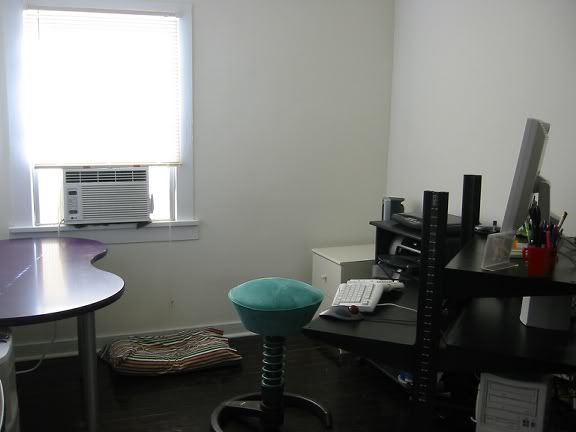
I've got a great new arrangement of the furniture in my study now:
Image hosted by Photobucket.com

And I'm about one-third of the way through sorting my stuff. Cleaned out all the storage drawers, and got rid of two big bags full of things. I've been dealing with objects first, then I'll tackle the paper filing, which is much easier than all the weird miscellaneous stuff that somehow winds up in my study.

boring, isn't it? but I know it will make this a better year.

Meanwhile my gf is cleaning out the garage. We are Industrious and Highly Caffeinated this weekend.

1/06/2006

that feng shui book

Yeah, I know, it's pretty ironic that there's a feng shui book visible in the picture of my piled-on desk. (Which is now completely cleared off!) But there's a reason. I think one of the problems I've been having in this study has to do with its arrangement. I've never been fully satisfied with it, and it's not a room that feels good to spend time in. So I figured that I'd consult a couple of books for ideas prior to my moving the furniture. (The arrangement it's been in has mostly been due to the semi-random placement of the filing cabinets as we were moving in -- that plus the windows didn't seem to give me many options. But I can move the files, if I have to. And I think I will.)

I own a feng shui book that I've found helpful -- clear and easy to understand, even if her writing style includes a few too many jokes for my taste: Move Your Stuff, Change Your Life by Karen Rauch Carter. But I picked up a few others from the downtown library yesterday just to compare and see if they had workspace-specific tips that could be helpful. Anyway, it turns out that because of the shape of our house, there might be an energetic reason that my study has never been a great work spot. So there are some things I'm going to try that might help me transform the room.

I didn't even own a desk for something like 15 or 20 years, because I feared that it would just wind up covered in stacks. I don't usually sit at a desk -- I'm either at the computer table, or I'm reading/grading on the couch in the living room. But there are certain kinds of tasks that I do like to have a work surface for. So I got this desk a couple of years ago and I did try to keep it clear. But ever since we moved to this house last summer, it's been a disaster.

But all this can change. And I'm starting now.

Tryday

Today is the beginning of Super Clean Up weekend at our house. My study is in a Frightful State, so bad that I have been finding myself procrastinating on even going near the stacks of stuff I have to weed through, recycle, shred, and file.

via Lisa I saw Jennifer Crusie's picture of her workspace, which was mildly cheering. Though if you're an incredibly popular bestselling novelist it really doesn't matter if your office is a mess, now does it?

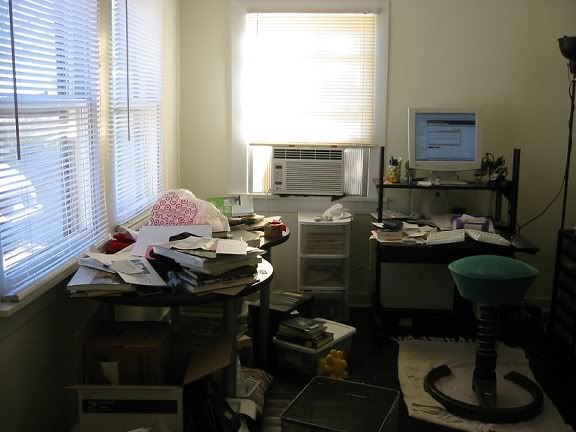
But it inspired me to my own bit of public humiliation. This is my study right now:
Image hosted by Photobucket.com

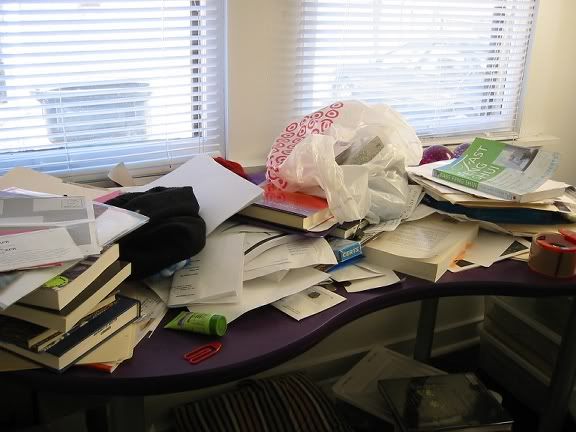
which includes the horrifying mess that is the desk:
Image hosted by Photobucket.com

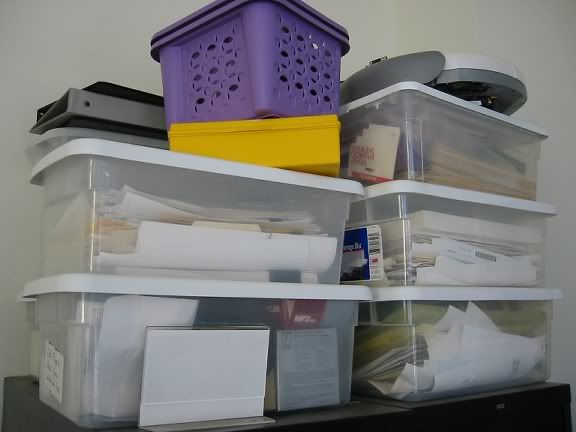
and large amounts of paper crap that can probably be gotten rid of but all needs sorting through:
Image hosted by Photobucket.com

Tasks for today:
  • deposit check at bank
  • answer work emails
  • pay bills
  • clear the work surfaces in the study: books to shelves, papers in crate for temporary holding, random items where they belong
  • sweep the floor
  • rearrange the furniture (one of the many things I don't like about my workspace)
  • go through stack of mail and shred/file/recycle as appropriate
  • 20 minutes of sorting and filing of the work surface papers
  • take dogs to park
  • yoga class!

1/04/2006

post MLA post

I'm a bit late in my post-MLA post -- I'm finding that these past couple of days have been some kind of time sinkhole -- I've been working out like 3 hours a day and playing with the dogs and cleaning the house and cooking and starting on my Monstrous Reorganizing Project -- and whew, there's the day. Obviously, this can't go on much longer, since I have to finish an essay in the next 10 days and prep courses and all that other brainwork.

I really enjoyed MLA this year -- as I usually do. I know so many people who are still wounded from the job market and who loathe MLA -- but oddly enough I always really like it. I've been thinking about why that is, and I think it's something tribal. MLA is the one place where I feel like I'm part of something bigger, like I belong with a group of people. Of course, as a second-generation academic, this might make some kind of sense (supposedly I attended an MLA with my parents when I was 2 1/2 but I don't remember it). But at a deeper level I generally have a strong distrust of groups, of seemingly artificial communities. I was raised without any kind of religious community, youth group, sports team, or other such organizations that probably promote social skills and a sense of belonging. I'm an introverted, overeducated nerd -- so mostly I don't walk into a room of strangers and think "ah, I fit in here."

But at the MLA, I know I fit. And I know that I fit somewhere in the middle of the spectrum -- I'm not the nerdiest, the smartest, the ugliest, the leftiest, the most fashionable. I'm right in the middle. And I very very rarely get to be middle-of-the-road average. It's kind of relaxing.

Sure, I enjoy the anthropological aspect of the convention, playing the game of "Spot the MLA people" while walking around the city, and laughing at, hugging, or hiding from various people from my PhD dept. But I'm allowed to gently mock our sartorial habits and our social skills because I'm one of the crowd. There are plenty of people at MLA who look like me, think like me, who are basically somehow kind of like me. And I guess that's why I always enjoy the convention.

Plus, of course, the obvious enjoyments. Even though I was on a hiring comittee, I was able to see old friends from grad school (this year I saw folks I hadn't seen in 10 years or more!), see old college friends who live in DC, go to some interesting panels, browse the book exhibit, and even do a little networking. I had a great time and came away feeling much more energized about this profession than I usually do here in my local territory. If only I could bottle that feeling and dose it out once a month during the semester...

1/01/2006

2006

I'm really looking forward to the year ahead. Of course, for me the academic "year" is the one I tend to think with -- when I have to remember a particular event, I usually have to think about which year in school I was. But I'm a big believer in fresh starts (being an academic allowing us three of these per year!) and setting goals, and rituals. So the new year is always worth noting.
Looking back at 2005, I can see that it was a time of change. All of it now seems preparatory, anticipatory of the bigger changes I'd like to make happen on the horizon. But, among other things:
  • My gf and I got married in February as part of a Marriage Equality protest -- a group wedding ceremony for 80 couples. But it was also much more than just a political act -- it crystallized our commitment to each other and the stability of our relationship. Looking back, it was one of the most significant moments of the year, even though it was something we decided to do only a couple of days before, without the party and planning and hoopla that usually would accompany a ceremony. Someday it'll be nice to have a big party for our faraway friends, but that's not in our budget or our priorities right now. And doing it just by ourselves actually intensified the experience.
  • We moved to a new house in June -- again, another major life decision we made very quickly. Things in our last place became increasingly untenable (crazy landlords, construction across the street, etc) and we found this great new place very quickly. The move was chaotic and it took us many weeks to finish unpacking, but it was one of the best things we could have done. We've all been so much happier here -- we have more space, the dogs have a better yard, and the energy of our home is vastly improved.
  • I taught summer school for the first time in an effort to come to terms with my debt load. Of course, some of the all-too-small extra stipend went to cover the deposit on our new place, etc, but it was an important act in trying to remedy a situation that makes me feel anxious and guilty.
  • I took on a half-time administrative post in my department -- which is expected once you get tenure, but I'm doing it not simply out of a willingness to be a good citizen. I'm looking at these three years as a chance to learn how the university functions and to discover whether I'm interested in an administrative path in my future.
  • I made a difficult and important decision about letting go of an old research project and moving forward with two new projects that reflect my current interests and expertise.
Thinking about these decisions and events shows me how much of 2005 was consciously or unconsciously about getting ready for a productive and energizing future. I had a lot of things that were weighing me down in 2003, 2004 -- the tenure process, some personal stuff, some blockages. And I've cleared through a lot of that and opened up some new gateways.

So, for 2006, I have a number of goals, and a couple of resolutions -- which I've always distinguished as the small daily actions that can create change -- and thereby help towards my goals.
  • make my physical health a priority -- which means stepping up on my gym training schedule as well as my yoga commitment. Luckily, I enjoy working out -- that's never the issue. But the time scheduling hasn't always been easy and over the past couple of years I scaled back on the lifting in order to fit in more yoga. This year I will make more time for both.
  • taking care of physical health also means getting back to my supplement routine. I feel better when I take vitamin and mineral supplements but ever since I changed my morning meal to all liquids, I've been less likely to take them because of stomach upset. So, duh, I have to take the supplements at midday instead. With a little planning and 28 days of effort I should be able to make this a habit.
  • try cooking some new recipes -- maybe one a month.
  • I'm really going to make the 28 day effort to do small daily writing sessions (a method I've recommend to others and watched them succeed with. So it's time to take my own advice).
  • blog more! I'm always happier when I'm reading and writing more.
I'll write about my outcome-oriented goals some other day. But these steps are simple daily actions that would help make this next year a better one.

12/27/2005

and I'm off...

...to MLA! Where I probably won't have blog access. I'll just be storing up stories and observations to report upon my return.

12/25/2005

party day

I got a huge box of plush dog toys super cheap online this year so the dogs had a lot of fun opening their stockings!
Image hosted by Photobucket.com

Image hosted by Photobucket.com

Image hosted by Photobucket.com

And then my gf and I exchanged gifts and played with the dogs for several hours. Much ball tossing, rope tugging, toy disembowling, and cookie eating. Then a movie and pizza and a trip to the dog park and now we're home, all of us kind of played out but really really happy.

12/24/2005

fever free

Throughout my illness, the dogs have been taking their jobs as nurses very seriously, staying in bed with me even when they could have been playing outside in the yard. Most of the time one or both of them have been snuggled right up against me, pinning me tightly in the bed as I slept. (They're happy about the snuggle time but I suspect they also were enjoying my elevated body temperature, since dogs run much warmer than humans do.)

Because of their natural diet, our dogs are very fresh smelling most of the time. But whenever our youngest dog gets wet (whether in the rain, or from a bath) her hair gives off this funny smell, sort of like the old-fashioned permanent smell in the old-lady hairdresser shop my mother went to when I was a kid. Acrid, bitter, sort of surprising. But as soon as she's dry,the smell goes away.

About 4 a.m. I woke up with that smell in my nose and realized that I had soaked her with my sweat as my fever broke. My clothes were drenched, the blankets were damp, but most of all G was damp, since she'd been nestled up against me. Our other dog was perched on my shoulders, keeping some of my body heat in, as my damp skin was quickly over-cooling.

So I got up and changed clothes and dried the dogs and we all went back to sleep. And today I'm much much better! Still kind of tired, but I feel more like myself. And the dogs are happy to be playing outside again, their duties as nursemaids done.

12/23/2005

101.7

I got hit with a stomach virus yesterday -- don't know whether to blame the family party or the lunch out with friends -- both of which probably would have put me in contact with holiday germs. Ick.

I thought a lot about blogging yesterday -- but since I was only semi coherent due to my fever, it's probably just as well that I couldn't.

but hey, today I've graduated to applesauce and even a piece of toast! which seems like cuisine compared to glasses of gatorade and tea, which is all I could handle yesterday.

real thoughts to commence once I get them...

12/19/2005

Student portraits

Student 1: He sits in the front row every day, and misses only one class all term. His writing needs some work, especially in transitioning between ideas and avoiding repetition, because he's not a native speaker. He comes to meet with me two or three times for every assignment in the course, both before and after it's graded, to go over my comments and learn about what I'm trying to teach him. He's taking several advanced level literature courses (something that is challenging for most of our native speakers, never mind someone who only came here four years ago) and we also spend time working on his close reading skills. In the schooling he received in his country of origin, students were not expected to write essays based on their own arguments or opinions; they were only supposed to learn the teacher's words by rote memory. It is a huge paradigm shift for him to try and succeed in this educational culture which prizes logical argument and clarity of expression. He learns to recognize the differences in what is expected of him here, so that even if he is not always successful in crafting his written arguments, he can analyze and learn from his mistakes. When I suggest that he read a book on improving his syntax & style, he actually does, and I can see the results as his writing improves. He brings in ideas from his philosophy class and tries to relate them to the literary texts we're reading. He is engaged with the material and actively trying to improve his writing. He was not an A-level student when he entered my class, but his commitment to fulfilling all assignments, to benefit from the opportunity to get comments on drafts, and his A+ final exam brought his final grade up to A-. A grade I was happy to give him.

Student 2: Her attendence was extremely erratic, so much so that for a while I thought she had dropped the course. (With our student population at my U, you can usually expect to lose a few students along the way, and they often don't let you know. They just stop showing up.) But then she showed up again, briefly. When she was in class, she never participated in discussion, but sat with a sneering sulky look on her face. As I totalled up the attendance records, I realized she had only been there one-third of the course days. She turned in only two of the weekly assignments. But her writing is very strong and I think she's smart. Her first paper was good enough that I checked it several times for plagiarism. Her oral presentation was also very good. Her lack of involvement in the course was all the more frustrating to me because I sensed that she was naturally a strong student. She never turned in her final paper, not when it was due nor during the grace period I allow for late work (specified very clearly in my syllabus). Her final exam was at the C level, but because she'd missed so much work, her final grade was an F. Two days after turning in my final grades, she emails me her final paper, saying "I know it's probably too late to be graded." I glanced at it, even though I'm not accepting it for a grade, and sadly, it's a very strong paper. If she'd turned it in on time, she'd have passed the course. (just barely, but she probably would have passed). If she had a medical or personal situation that required accomodation, I would have been more than happy to help her. But never once did she contact me with an explanation about her absences or her missing work. I don't know what her story really is.

One of the qualities I try to cultivate in myself as a teacher is an attitude of generosity. I gladly spent long hours working with Student 1, because that's part of my work as a teacher. I make myself available to students during regular office hours and via email. I make accomodations for students with special needs, with medical conditions, or with family situations that cause them to miss class or fall behind in their work. My courses require regular assignments to be turned in -- some of which are graded simply on a particpation basis, so that if you do them, you get full credit. So putting forth serious effort actually does improve your course grade. I don't penalize students for missing class, but point out to them that if they miss too many classes, their assignments will necessarily suffer.

I don't think, however, that it would be generous to simply grade Student 2's four-week-late paper and give her a passing grade. I've thought a lot about this over the past two days. If she had contacted me at any time during the semester with a reasonable explanation -- a medical condition, for instance -- I would have worked with her either to establish due dates for her written work and a plan to improve her attendance, or to give her the passing-Withdrawal grade. But from everything I've seen of Student 2's behavior, she's smart enough that she thinks she can get by without doing the things that are required of everyone else. She's got an issue with authority, maybe some sort of issue with being in school at all. In a small-section (30) lecture-discussion course, you can't just act the way you might in a large lecture format course. You can't just read the books and still ace the exam. Part of the work of the course happens during the class. Otherwise I could just proctor study hall every day instead of actually teaching.

I feel frustrated with Student 2 -- and I felt frustrated with her during the semester, too. I'll always feel that I could have somehow tried harder to reach her. But her performance in my class is not only my responsibility -- it's also hers.

12/15/2005

I can see the finish line

I'm getting really close. Everything is graded, and almost everything is entered into the spreadsheet. I still have to convert some letter grades to numbers and finalize a couple of formulas that are dependent on the number of class days etc. I already combed through my email inbox for any stray response papers that I hadn't printed out and therefore already entered into the gradesheet. I'm getting really close to wrapping this up. But I lost some of my momentum at 5:45 when I knew I wouldn't be done in time to get to yoga. (And then I got sidetracked deleting a bunch of other old emails that I no longer need to keep.) For some reason, the final calculation of grades always takes me longer than I think -- even though the spreadsheet does a lot of the work. Even once I clean up the formulas, then I still have to eyeball the grades, and make sure they make sense. And then do the scantron sheet, since we're still stuck in the quadplicate paper forms era at my U. But it's really the decisions that slow me down -- is this student's participation grade really a B or an A? etc.

But the end is really, really, near. And it really wasn't too bad, since this was a light teaching semester for me.

And tomorrow is going to be the most enjoyable day off EVER. I'm going to sleep! and read! and go to yoga! and go to the gym! and go out to lunch! and maybe even catch a movie. I'm going to just totally play, all day long. Saturday will be time enough to begin working on my 9,000 projects slated for the winter break.

how to have fun on Thursday

How to have fun (or is that "fun"?) at work:
  • drink SBX with extra shots in it
  • change pens periodically while grading final exams
  • be meeting in a windowless conference room when the power goes out
  • be within six hours of wrapping up the semester . . .

12/14/2005

the Wikipedia thing

I first read about the latest Wikipedia "controversies" on Monday, though it's apparently been going on for a while.

The flurry of media attention was drawn to Wikipedia because John Seigenthaler wrote an op-ed piece for USA Today criticizing the site's open-access approach to information because he had been named in an entry related to the Kennedy assassination. His essay focuses on the impossibility of tracking down who wrote false statements about him, and criticizes Wikipedia writers as "volunteer vandals with poison-pen intellects". While his personal sense of outrage is perhaps understandable, his essay clearly shows the gap between older conceptions of publishing and what the web really offers. Several things come to mind.

First, why didn't he just change the entry himself? or have one of his minions do it? (In the past few days, on the heels of this issue, Wikipedia has changed the rules so that only registered users will be able to contribute information, allowing all changes to be tracked to a particular user.)

Second, no one with any sense would take a Wikipedia article on a super-controversial (and potentially wacky) topic like the Kennedy assassination very seriously.

The man who wrote the false information about Seigenthaler has since apologized and been fired from his job. He apparently didn't think any one used Wikipedia as a serious information tool. That doesn't mean it's justifiable to write a slanderous statement as a prank. But the status of Wikipedia as an information source is somewhere between "totally non serious" and "acceptable to teams of establishment experts."

Entries on tamer stuff don't change that often and are generally pretty reliable (you want to learn who were the key names in the history of, say, watchmaking, you can quickly check Wikipedia and then go forward with your research). But certain topic stems are of course magnets for opinionated folks, and the site editors can't keep up with everything. But usually (and I don't know why this didn't happen in this case) some other opinionated writer will step in and change it again.

The head of Wikipedia has now come out suggesting that no one should cite the site, but that it should be used as a starting point for further research. He also points out that no one doing real research should be citing any sort of encyclopedia, because the kinds of information they provide are very limited and prone to error.

But that doesn't mean throwing out the baby with the bathwater is the right response either, and Seigenthaler's mutterings about how Congress "enabled" and "protects" Wikipedia writers suggest a deep distrust of new media that risks violating the free exchange of information and opinion.

I think Wikipedia is one of the great things on the web -- largely because it shows (like some other key online ventures like Ebay) that much of the time, most of the people are mostly good intentioned. The fact that volunteers with knowledge about particular topics choose to spend their time writing about them is pretty awesome. Wikipedia is also extremely flexible and dynamic, allowing it to register developments in popular culture and slang that never make it in to print or print-equivalent sources. There are topic stems that also wouldn't make it into the traditional information architecture. The web gives voice to information and opinions from a much broader range of persons than any traditional medium.

Of course the media loves controversy. So items that encourage paranoia and distrust of internet-based communication, commerce, or culture always get more play than items celebrating those things.

Seems like there's lots of teachable material in this event for instructors at all levels...

12/10/2005

guess it'll have to be a 1000 words

It looks like this is yet another year when we won't be sending a photo holiday card. You know, the cheery picture-equals-all-the-words-not-written kind of glossy holiday card that I've been receiving from many of my friends in the past few years. I'd much rather get a photo card that just has a signature scribbled on it than a regular card that's just signed. Alas, I know that the days are long past when I could count on personal notes or letters tucked into the xmas cards. I still tend to write a few sentences at least in the cards I send -- it's one of the holiday rituals that I really enjoy. I like to receive cards, and I also like sending them. Although I've been kind of slack about it over the past couple of years, and so the number that I receive is slowly dwindling. Plus so many of us are email-only these days -- some friends I don't even have postal addresses for any more.

I like to give and get holiday cards. I've usually picked handsome arty cards or lefty environmental cards, always with the most secular message I could find.

I've never liked having my picture taken. I'm only recently a camera user & owner myself. I have very few pictures of myself past the age of ten -- I tend to close my eyes, double my chin, stare off vacantly, and generally ruin almost any picture I'm in.

So why, I wonder, have I been so interested in creating a photo card? About three years ago my gf and I managed to get ourselves and the two dogs lined up in front of the camera with its timer on, and got a semi-decent picture after several tries. It was too late in the year to actually print them and mail them (plus I was new to the whole digital photo printer thing), but I did send email holiday greetings with the picture.

That was the closest we've come. Every year we talk about taking a picture. The week before Thanksgiving, a friend was supposed to come to the park with us to get our picture -- we'd discovered that we were dressed kind of nicely that day, all by accident. But she didn't show up, the daylight was dwindling, and we had a guy we know from the park take a few pictures of us. We were so close. Unfortunately, the only pics that came out (he was a little shaky, and the dogs weren't exactly sitting precisely still) were taken from too far away -- they're not going to work for the photo card, and when cropped they're too low resolution.

And ever since Thanksgiving we've been too busy. So I think tomorrow I need to go to the bookstore and pick out some cards to send this year, without a picture. But considering that I hate the way I look in pictures, and that I don't usually want my picture taken, it is actually kind of strange that I've been wanting to do a photo card. I guess it has something to do with making my life real and visible to my long distance friends, some of whom have never met my partner or our dogs. Perhaps a kind of counterbalance to all the breeders & baby pictures that my mailbox fills up with.

12/09/2005

Dr Grumpy

I've been buried under a stack of job files -- our searches having been somewhat delayed by the Provost's office, our incompetent clerical staff, and the endless meetings about procedures required by the U's legal departments. This is the fifth search I've been on from the hiring side of things -- and the first since getting tenure. It does feel a little bit different this time around -- but I'm not entirely sure if it's how I've changed or the circumstances of this search.

I've always felt that the work leading up to hiring decisions was one of the most important kinds of departmental service I could do -- after all, as someone relatively early in my career (and especially now that I have tenure), I have a vested interest in helping to choose people who could be my colleagues for a Very Long Time. Plus, my department includes a couple of tenured faculty who it is widely felt were not the right choices -- so I've seen how mistakes in hiring (and tenuring) can really burn a department or college.

Reading job files always simultaneously makes me feel excited (new smart people! interesting topics!) and depressed ((1) all these smart people who have lousy jobs or don't have jobs at all and (2) all these not-so-smart people who shouldn't ever have been encouraged to get a PhD at Crap University because now what are they going to do, really?). During my first couple years in the job I would sometimes also feel a bit anxious about my own qualifications -- why did I have a job when obviously there were so many other super smart more accomplished people out there. Happily for me, I don't get that anxiety any longer from the job applications. I'm far enough removed from the fresh-PhD stage of things to not feel competitive with these folks. In fact, many of them seem outrageously young and unformed to me. (I do get imposter syndrome anxiety from other things, like reading the MLA convention program, but that's for another post.)

But today, I'm feeling like Dr Grumpy. The sheer burden of reading approximately 700 pages of writing samples in a subfield that is not my own, in order to prepare for a meeting that will undoubtedly result in one colleague insisting on more meetings, another only championing the male candidates, and a third stomping out of the room in a huff -- combined with the work I still need to finish in giving & grading exams, calculating final grades, and oh, yes, grading some late papers -- has me kind of off-kilter. If I can just make it to the 20th, all will be well. But getting to the end of the semester feels like a long haul right now.

12/05/2005

rethinking grading

I'd really thought I could get through this set of papers without blogging about them, without complaining about them. After all, I was so virtuous, I even graded some of them on Friday night. And the assignment I'm grading is a potentially interesting one that allows for creative or original responses on the part of the students. So they're not as dreary to read as some more traditional critical essays. (Also harder to plagiarise.)

But then I just didn't get much further with the grading over the weekend. It is the one thing that I truly seem to procrastinate on -- much worse than on anything else in my life. Even when it's not so painful, it's really hard to make myself sit down to do it. Especially since I was trying to grade at home -- I'd been at the office so much that I wanted to be at home with the dogs, all cozy on the couch. Which was great, but it also set me up to be distracted and interrupted.

So once I wrap up here at the office, I'm off to the cafe, where it will be warmer than my house (I hope), and where there will be anxious kids studying for the LSAT and med students doing whatever they do with flash cards. My best studying-related memories from college are all about being in places where other people are also working -- the undergraduate library's armchairs, the heavily varnished tables in the magazine room, the late-night coffees at the divey Italian place. In grad school, my best friend would come over to study -- we'd work for a few hours, breaking now and then for coffee or a snack. It was companionable but not overly distracting. I think that's the key. Working in total isolation can make me feel really put upon -- at least when it's a task I'm not really engaged with anyway.

I need to figure out a way to reframe grading as intellectual work. Because I think that's the problem -- it feels more like service, or adminstration, or other energy draining aspects of the job.

Or, maybe I can teach my dogs to grade papers for me...

12/03/2005

ETA for EOS: 13 days

Tonight is the first holiday party we have to go to. There's the "official" one for faculty hosted by my Department's Chair next week -- but tonight is the one that a colleague holds nearly every year -- a kind of selection from the dept, faculty and grad students, are usually invited. Since she caught me in the hall and said "you're coming on Saturday, right" I kind of have to go. And most years, it's been reasonably enjoyable. I'm just rarely in the party-going spirit at this time of year -- we're still teaching classes, stacks of papers are waiting to be graded, and there's a long final push to get this semester wrapped up.

And yet, at the same time, I'm also so over this semester already. My thoughts are with next term's classes, and more urgently with the work I hope to accomplish over the winter break. I spent the afternoon with my research instead of with the papers that I ought to grade -- but it feels like that was a good choice. Because it's all too easy for me to lose contact with my intellectual self, and just let the day-to-day task oriented self run the show. Especially right now, when there are job files to read and papers to grade and meetings to attend.

12/02/2005

Flux is fun

We went to an early matinee of Aeon Flux today, along with a few other hardcore film nerds and Friday slackers, and TOTALLY enjoyed it. The story's ingredients are familiar (philosophical issues around cloning, false consciousness, the price of privilege and comfort) but it's well done. And at a purely aesthetic level, the film is great -- beautiful art direction, costumes, lighting -- the whole look of it was very appealing to me. If you like dystopic SF with style, this is your movie. Plus, it was directed by a woman! (all too rare in SF) I can't compare it to the animated segments shown on MTV back in the day, since I didn't have a TV then and only heard about the show. But as a standalone film, I really liked it. (If you liked Gattaca, Fifth Element, Dark City, and/or Matrix 1, run, don't walk, to this one. But I certainly don't need to tell you that, if you liked those films.)

And let's hear it for kickass sexy action heroines -- we also got to see the trailer for Underworld: Evolution (the sequel), which looks equally delicious.